

Reviewed · WALKING TOURS
Brussels Tootbus Discovery Hop On Hop Off Bus and walking tours
Brussels is spread farther than its compact old center first suggests, and that is the main reason to consider this electric hop-on hop-off bus. In one broad circuit, you can connect Central Station, Grand-Place, the European Quarter, Cinquantenaire, and the Atomium without figuring out every tram or city bus.
I like the freedom to ride a full loop first, then return to the places that catch your eye. I also like the choice of a 24, 48, or 72-hour pass, plus multilingual audio, a children’s guide, and Tootwalk audio walks in the app.
The main catch is timing. Buses are expected at roughly 30-minute intervals, but traffic and service problems can stretch that wait. Stop signs can be easy to miss, and the app’s live bus information has not always been dependable.
Key points before you board
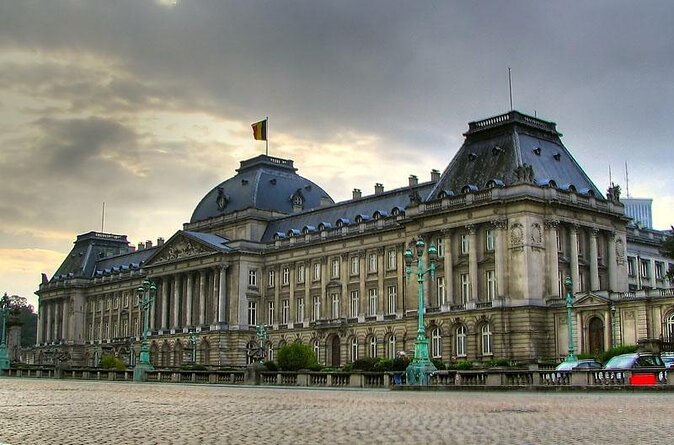
- A broad Brussels route: Reach Grand-Place, Manneken Pis, the European Quarter, Cinquantenaire, Place Royale, and the Atomium.
- A full loop takes time: Allow roughly two hours or more for a complete circuit, depending on traffic.
- Electric buses: The ride is powered by 100 percent electric buses, with free Wi-Fi on board.
- Audio comes in several forms: Use the onboard commentary, mobile commentary in the Tootbus app, a children’s guide, and Tootwalk audio walks.
- The Atomium requires planning: It is far from the historic center, and the return journey can be slow in traffic.
- Walking tours add value: A longer guided walk may also be available, including a four-hour walk led by Patrick, but confirm exactly what your selected booking includes.
What this Brussels bus pass is really good for
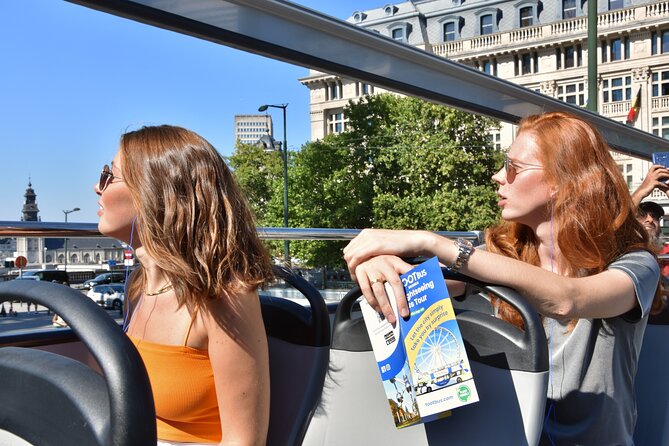
I would use Tootbus in Brussels as a first-day orientation tool, not as a guaranteed fast transport system. The route covers a lot of ground, which helps you understand how the old center relates to the royal quarter, European institutions, eastern parks, and the Atomium.
The bus is especially useful if you have only one day and want to see major sights without changing between trams and buses. It also works well if walking long distances is difficult. You can stay on for a full circuit, note the places you want to revisit, and then hop off when the route reaches your priority stop.
The pass is valid for the period you select: 24, 48, or 72 hours. A one-day visitor can get good value from the 24-hour option by riding the main loop, visiting one or two stops, and using the bus again later. The longer passes make more sense if you want a relaxed first ride on one day and several short hops on the next.
Do not buy a two-day ticket automatically. If your plan is only Grand-Place, Manneken Pis, the Royal Quarter, and nearby museums, much of that area is manageable on foot. The pass earns its keep when you use the longer links, especially the route to the Atomium and the European Quarter.
More Walking Tours in Brussels
- Brussels: Historical Walking Tour with Chocolate & Waffle Tasting
★ 5.0 · 1,165 reviews - Brussels Walking and Tasting Tour (Beers,Chocolates&Fries/Waffle)
★ 5.0 · 929 reviews - Brussels Chocolate Walking Tour and Workshop
★ 4.5 · 885 reviews
Start at Central Station and get your bearings
The main starting point is at Rue du Cardinal Mercier 33, beside Central Station. This is a practical place to begin because it links directly with Brussels’ rail network and puts you close to the historic center.
Before boarding, check the stop marker carefully. The signs can be placed high on the pole and are not always obvious at street level. This small detail matters because a missed stop can cost you half an hour or more.
I suggest taking a photo of the route map and checking the Tootbus app before you leave the station. The app includes your electronic ticket, stop information, bus tracking, and audio commentary. It is useful in principle, but do not plan your day around its live arrival time alone. Reported changes from one minute to 20 minutes make it wise to keep a backup plan.
Grand-Place and Manneken Pis: the strongest historic-center stop
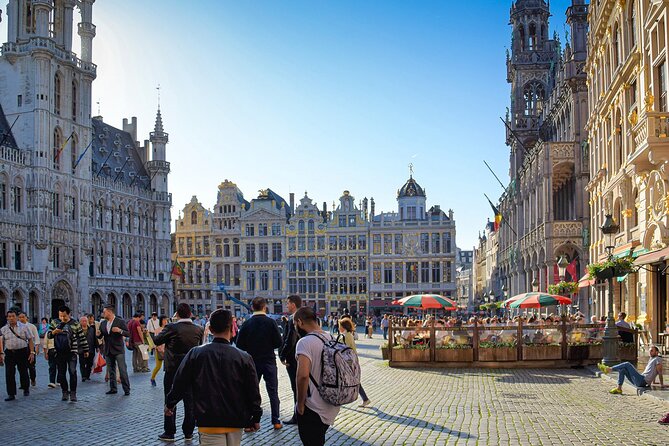
The stop at Rue du Lombard 68 serves Grand-Place and Manneken Pis. This is likely to be the most useful hop-off point for a first look at central Brussels.
Grand-Place is the city’s great architectural showpiece, while Manneken Pis is a short walk away. The two sights work well together, though the area around them is best explored on foot rather than from the bus. Get off here, walk the surrounding streets, and allow enough time to enjoy the square before returning to the stop.
The audio commentary can add context as you ride, but it may not always match the building directly outside your window. Some parts of the recording focus more on culture, music, or personal observations than on dates and architectural detail. If you want a tightly structured history lesson, you may find it light.
Still, this stop gives you the best chance to combine the bus with an independent walk. Use the ride to arrive, then put away the headphones and explore at street level.
Poelaert, Louise, and the Courthouse
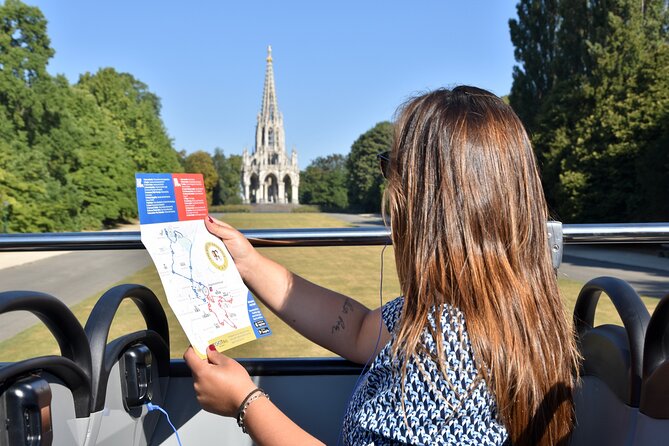
The stop on Rue des Quatre Bras serves Poelaert, Louise, and the Courthouse. This part of Brussels gives you a different feel from the narrow old streets around Grand-Place.
It is a useful stop for the city’s upper viewpoints and grand civic buildings. The route also helps show how quickly Brussels changes from the medieval center to broad avenues and formal architecture.
The drawback is that the bus route can feel slow across this part of the city, especially when traffic or road works interfere. If you are using the bus mainly as transportation, check how long the next bus may take before getting off. A short walk or public transport connection might sometimes save time, though the tour is intended to give you a wider city overview.
More hop-on hop-off routes in Brussels:
- Brussels: Hop-On Hop-Off Bus Tour
★ 4.0 · 4,016 reviews - Brussels: City Card with Hop-On Hop-Off Bus
★ 3.7 · 79 reviews - Brussels: Hop-On Hop-Off Bus Tour& Belgian Beer World Museum
★ 4.2 · 24 reviews - Ghent: Hop-on Hop-off Water-Tramway
★ 4.4 · 279 reviews
Luxembourg and the European Quarter
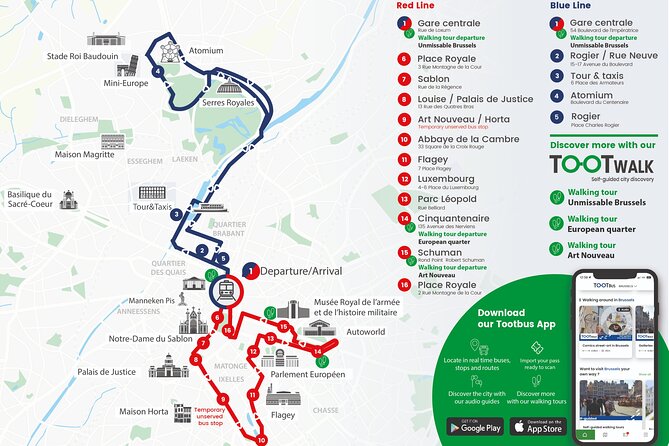
At Place du Luxembourg, the bus brings you to the European Quarter. This stop is valuable because the institutions and surrounding streets are not immediately next to the historic center.
The route lists the stop at Place du Luxembourg, near the European Parliament area. It is a good place to break up the old-town sightseeing with a look at modern European Brussels. You may also use it as a practical way to reach an area that would otherwise require extra navigation.
The commentary here is most useful if you want a broad explanation of the city’s political role. Do not expect every major building to receive equal attention. Some striking structures can pass without much explanation, and the recording may include quiet gaps or music.
If your main goal is the Parliament area, check your timing before you leave the bus. The broad circuit means that waiting for the next vehicle can affect museum or attraction reservations.
Cinquantenaire: a spacious park stop

The stop at Av. des Nerviens 131 serves Cinquantenaire. This is one of the route’s more welcome changes of pace, with open park space replacing dense city streets.
Cinquantenaire works well as a pause in a busy sightseeing day. You can get off, stretch your legs, and explore at your own speed before continuing. The stop also shows how broad Brussels is beyond the old center.
The bus ride through Brussels can be bumpy. Cobblestones, construction, and uneven streets are part of the experience, so the upper deck may not suit everyone on a cold, wet, or rough day. The open top deck gives better views, but it can feel cold even when the city itself is pleasant.
Place Royale and Brussels’ royal quarter
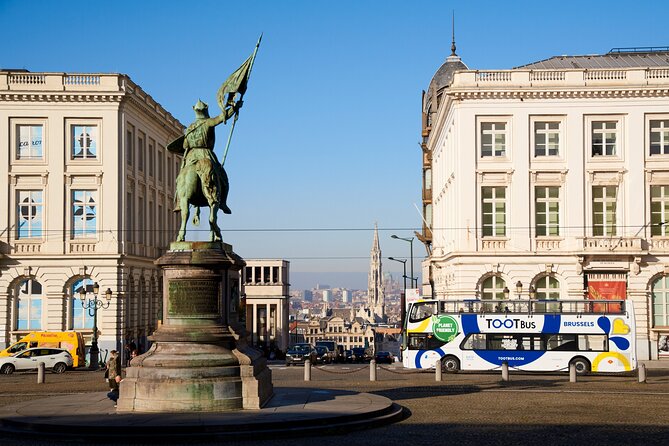
The stop at Rue de la Régence 2 serves Place Royale. This area is another good bridge between the historic core and Brussels’ formal royal and cultural district.
The ride is helpful if you want to see more of the city without treating every sight as a separate transport problem. You can use the audio to follow the route, then get off for museums, squares, or nearby streets.
Keep your expectations realistic about the commentary. The best parts give you a sense of place while you watch the city pass by. Other sections contain more music or general talk than precise information about the buildings in front of you. The experience is more pleasant when you treat the audio as an optional layer, not the sole reason for buying the ticket.
Atomium and Mini-Europe: the longest useful connection
The second route runs from Central Station through Rogier and out to Atomium and Mini-Europe. The Atomium stop is at Boulevard du Centenaire, and it is one of the biggest reasons to choose the bus over staying in the old center.
The Atomium is far enough from central Brussels that reaching it takes planning. Tootbus makes the connection simple on paper: stay on the route, get off at the stop, and use the bus again for the return. The problem is that traffic can make the ride from the Atomium back to the center take about an hour.
Allow extra time if you have a fixed booking at the Atomium or Mini-Europe. Long lines at the Atomium can add another delay, and the bus may not appear exactly when the app predicts. I would avoid scheduling a tight train departure or evening reservation after this stop.
This is also the route where service disruptions matter most. If a bus is removed from service or the return trip is interrupted, you can be left a long way from the center. Keep the public transport network or a taxi as a backup, and remember that separate city transport can cost extra.
Rogier and De Brouckère for central connections
The Rogier stop on Av. du Boulevard 21 and the De Brouckère stop on Rue de l’Evêque 7 give the route useful city-center links.
Rogier is practical for the northern side of the center, while De Brouckère puts you near central shopping, restaurants, and streets leading back toward the old town. These stops are less about one landmark and more about breaking a long circuit into manageable pieces.
The service pattern is the key issue. A bus that is scheduled about every 30 minutes may arrive later because of traffic, road works, or an operational problem. If you are hopping off for a quick photograph, keep the next departure in mind. A short stop can turn into a long wait.
Audio, Tootwalk, and the walking-tour option
The bus includes audio commentary in multiple languages, and you can also access commentary through the Tootbus app. There is a special children’s audio guide, which can help families keep younger passengers interested during the longer stretches.
The audio quality is uneven in practical terms. Some seat headphone sockets may not work, and some parts of the recording are more musical than informative. At times, the narration may not line up perfectly with the building or square you are passing. Bring your own sense of direction and use the app’s route information to identify stops.
Tootwalk is the app’s collection of audio-guided walking tours. This is a useful idea because Brussels is best experienced on foot once you reach the center. The walking content lets you move at your own speed instead of trying to see everything through a bus window.
There is also evidence of a longer guided walking experience, including a four-hour walk with a guide named Patrick. That walk received especially warm praise for its kind, well-informed guidance and inside view of the city. Because the supplied tour details describe the bus as approximately one hour while the bus loop can take much longer, confirm whether a guided walk is part of your chosen booking or a separate option.
What the electric bus is like on board
The buses are 100 percent electric, which makes the ride a quieter and cleaner way to cover a wide area. Free Wi-Fi is included, though service may not always connect reliably. I would treat it as a bonus rather than something you need for navigation.
The open upper deck offers the best views and photographs. It can also be cold, particularly in cooler months or when wind moves across the top. The lower deck provides shelter, but heating and air conditioning have not always performed well.
There is no restroom on board, and food and drinks are not included. Plan your stop around a café or public facility rather than expecting to remain on the bus for hours without a break.
The buses are generally suitable for most people, and service animals are allowed. The experience is near public transport, which helps if you need to switch to another mode after a long wait.
Is the pass good value?
The value depends on how much ground you cover. If you use it for one short ride between nearby central stops, it can be an expensive way to move around. Brussels’ old center is compact enough that walking often wins.
The pass becomes more useful when you combine several distant areas in one day. The Atomium, European Quarter, Cinquantenaire, Place Royale, and Grand-Place are spread across a large area. Covering them in one vehicle saves planning time, even if the bus itself is slowed by city traffic.
A 24-hour ticket is the safest choice for a first visit. It gives you time to complete a loop, return to one or two favorite areas, and adjust if a bus arrives late. A 48 or 72-hour ticket is worthwhile only if you intend to use the bus on several separate days.
Discounted booking prices can improve the calculation. Still, compare the pass with Brussels’ regular public transport before booking. If you mainly want Atomium and the central sights, a combination of train, tram, or city bus may be quicker.
How I would plan the day
I would start at Central Station and ride enough of the route to understand the city’s layout. Then I would get off at Grand-Place and walk through the historic center.
Next, I would choose either the European Quarter or Cinquantenaire, not both, unless I had plenty of time. I would save Atomium for a large block of time, with no tight appointment after it.
For a one-day visit, this plan is sensible:
- Begin at Central Station.
- Ride toward Grand-Place and Manneken Pis.
- Walk the old center.
- Continue toward Place Royale or Luxembourg.
- Take a break around Cinquantenaire or the European Quarter.
- Visit Atomium only if you can spare the long return journey.
- Use the app for route details, but confirm the physical stop sign before waiting.
If the bus has not appeared after a long wait, do not keep standing there simply because the app predicts one minute. Check another transport option and protect your sightseeing time.
Who should book this experience?
This works best for you if you want a broad first look at Brussels, prefer not to plan several public transport connections, or want an easy way to reach the Atomium. Families may appreciate the children’s audio guide, and visitors with limited walking stamina may like the chance to rest between sights.
It is less suitable if you want fast point-to-point transport, detailed historical narration, reliable live tracking, or a tightly timed schedule. The bus is also not ideal if you are sensitive to cold, heat, rough roads, or long waits.
The free cancellation policy is generous: cancel at least 24 hours before the start time for a full refund. Changes or cancellations inside that 24-hour window are not accepted for a refund.
Should you book the Brussels Tootbus?
Book it if your priority is seeing the shape of Brussels in one ride and reaching distant sights without working out every connection. Choose 24 hours for a short visit, and use the bus as an orientation and sightseeing tool rather than assuming it will run like a frequent city shuttle.
Skip it if your plans focus only on central Brussels, or if you need exact arrival times. For the best result, check the stop markers, allow generous time around Atomium, dress for the open deck, and keep public transport as a backup. Used with those limits in mind, Tootbus can save effort and show you more of Brussels than the old center alone.
FAQ
How long is the Brussels Tootbus experience?
The listed experience duration is approximately one hour, but a complete sightseeing circuit can take around two hours or more depending on the route and traffic.
Which ticket durations are available?
You can choose a 24-hour, 48-hour, or 72-hour Brussels hop-on hop-off pass.
Which major sights are included on the routes?
The stops include Central Station, Grand-Place, Manneken Pis, Poelaert and the Courthouse, Luxembourg, Cinquantenaire, Place Royale, Rogier, Atomium, Mini-Europe, and De Brouckère.
Is audio commentary included?
Yes. Audio commentary is available in multiple languages on the bus and through the Tootbus app. A children’s audio guide is also available.
Does the bus have Wi-Fi and restrooms?
Free Wi-Fi is included on board. There is no restroom on the bus, and food and drinks are not included.
Can I cancel for a full refund?
Yes, if you cancel at least 24 hours before the experience start time. Cancellations or changes made less than 24 hours in advance are not accepted for a refund.
Just added around Brussels
- Standard vehicle from Brussels airport to city of Antwerp★ 5.0 · 4 reviews
- Luxury Minivan from Brussels airport to the city of Brussels★ 4.0 · 7 reviews
- Transfer Brussels Airport (BRU) –> City Center 7 PAX (ONE WAY)★ 5.0 · 7 reviews
- Luxury vehicle from Brussels airport to the city of Brussels★ 4.0 · 5 reviews
- Transfer Brussels Airport –> Brussels MB V Class 7 PAX (ONE WAY)★ 5.0 · 4 reviews
- Transfer Brussels Airport –> City MB E Class 1-3 PAX (ONE WAY)★ 5.0 · 6 reviews
- PRIVATE MPV TRANSFER FROM/TO BRUSSELS AIRPORT (Max 6 pax) ONE-WAY★ 5.0 · 4 reviews
- Waterloo Private Battlegrounds Tour with Lion Hill★ 4.5 · 9 reviews
Walking Tours, compared.

Small Group Boat Cruise and Guided Walking Tour
Read our review →
Walking Tour, Canal Boat Trip w/Beer Tasting Option
Read our review →


Historical Walking Tour with Chocolate & Waffle Tasting
Read our review →
Brussels Walking and Tasting Tour (Beers,Chocolates&Fries/Waffle)
Read our review →
Browse the lists this tour appears in