
Reviewed · HISTORICAL TOURS
Antwerp: Private 3-Hour Historical Sightseeing Walking Tour
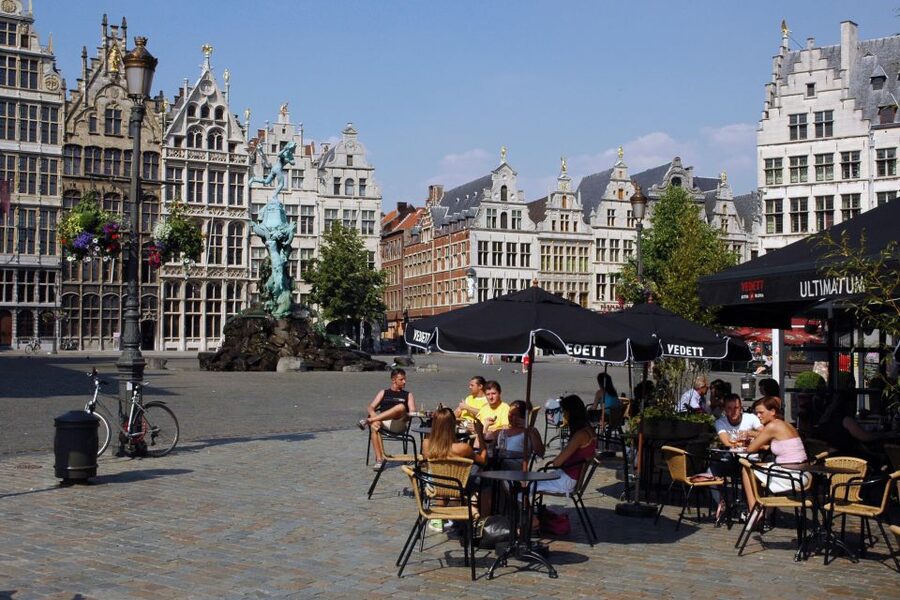
Antwerp’s story comes into focus as you walk from the Brabo Fountain through the old quarter to Central Station. In three hours, you see the city’s grandest squares, crooked medieval lanes, Flemish art, merchant architecture, and one of Europe’s most striking railway buildings. The route packs in a lot, but it gives you a useful first map of central Antwerp.
I like the private format, especially if you want to ask questions or adjust the pace. I also like the mix of famous sights and smaller corners, from the 16th and 17th century guild houses to Vlaeykensgang’s narrow lanes. The main catch is mobility: uneven streets, long walking, and several stops make this a poor fit for wheelchair users or anyone with limited mobility.
Key points at a glance
- A private three-hour route: Your group of up to 20 has its own guide, with no larger public group to follow.
- Antwerp’s grandest architecture: Grote Markt, Renaissance City Hall, guild houses, and Central Station form the tour’s visual backbone.
- A strong art connection: Our Lady Cathedral contains works by Flemish masters, while the route passes Rubens House.
- A medieval change of pace: Vlaeykensgang offers narrow lanes and crooked alleyways away from the city’s broad shopping streets.
- Flexible language choice: Tours are offered in Dutch, English, French, or German.
- A guide can shape the walk: Luc and Rosemarie are specifically praised for clear explanations, humor, flexibility, and attention to individual interests.
Starting beside the Brabo Fountain
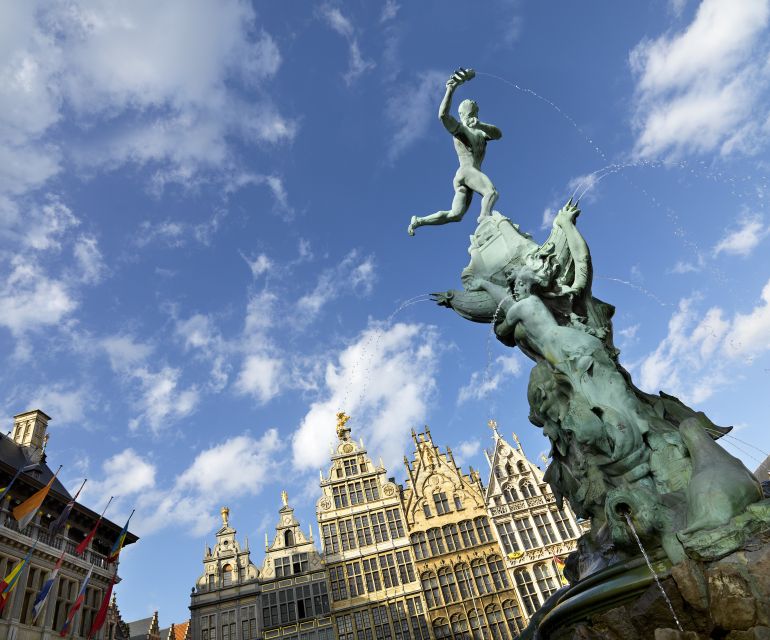
The stated meeting point is the Brabo Fountain at Grote Markt, Antwerp’s main historic square. One practical note matters here: the activity description also refers to meeting your guide in a hotel lobby. Because the detailed meeting information names Brabo Fountain, confirm the exact pickup arrangement before you set out.
The fountain is an easy place to recognize your guide. It sits in the middle of Grote Markt and gives the tour an immediate sense of place. The sculpture was inaugurated in 1887 and is tied to the old legend of Silvius Brabo, the figure associated with Antwerp’s name and the severed hand shown in the fountain’s design.
You do not need to know the legend beforehand. Your guide uses the square to explain how Antwerp’s stories, trade, civic power, and architecture came together. This is a good opening because you are not simply looking at attractive buildings. You are learning how to read the symbols around you.
Grote Markt can feel busy, especially around the center of the old quarter. That creates a small practical problem: city noise may make a guide harder to hear at times. One German-speaking participant specifically found the guide difficult to understand in places because of street noise. Stay close, face your guide when possible, and ask for a repeat if you miss a point.
More Historical Tours in Antwerp
- Historical Walking Tour: Legends of Antwerp
★ 5.0 · 1,837 reviews - Antwerp: Historical Walking Tour in the Old City
★ 4.8 · 373 reviews - Private tour: Highlights & History of Antwerp
★ 5.0 · 299 reviews
Grote Markt and the Renaissance City Hall
From the fountain, the focus turns to the Renaissance City Hall and the guild houses around the square. This is one of the strongest parts of the route for architecture lovers. The buildings are tall, narrow, decorative, and packed tightly around the open square.
The guild houses reflect the power of Antwerp’s trades and civic groups during the 16th and 17th centuries. Their façades are not background decoration. They tell you that merchants, craftsmen, and city officials wanted their status displayed in stone, brick, ornament, and shaped rooflines.
I like having a guide here because the details can blur together when you walk alone. A good explanation helps you distinguish the City Hall from the guild houses and understand why the square became such an important public stage. Guides have also been willing to pause at individual buildings when a group showed particular interest.
This section rewards a slow look upward. The lower parts of the square can be crowded, but the best details are above eye level: sculptural decoration, stepped rooflines, and the varied façades that give Grote Markt its character. Keep your phone or camera ready, but do not spend the whole stop looking through a screen.
Our Lady Cathedral and Flemish masterpieces
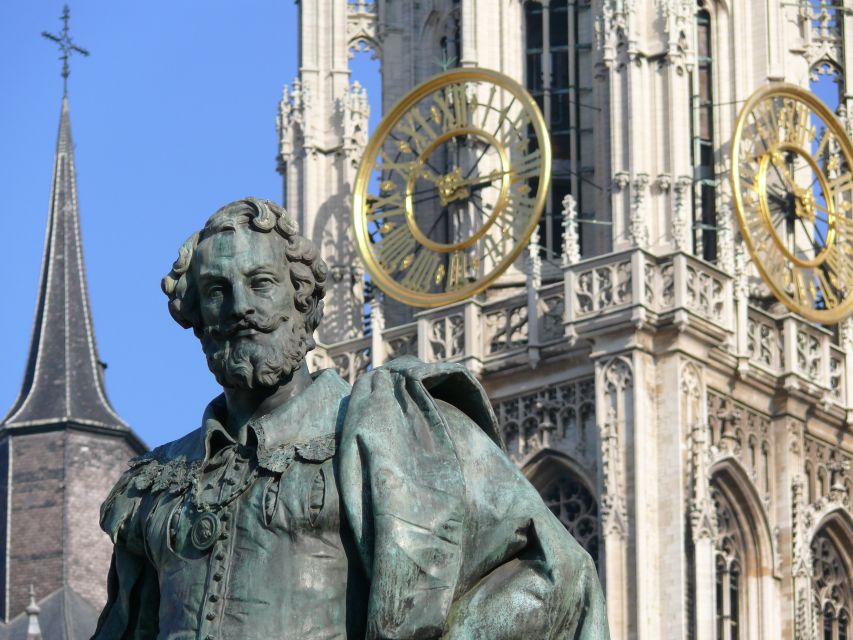
The route continues to the Cathedral of Our Lady, Antwerp’s most important church and one of the city’s major art stops. The cathedral houses works by famous Flemish masters, giving the walking tour a stronger cultural focus than a simple exterior sightseeing circuit.
Entrance fees are not included, so check the admission cost when planning your budget. The tour includes the visit, but you should not assume that admission is covered in the $341 group price.
The cathedral is particularly useful for anyone who wants to connect Antwerp’s buildings with Flemish painting. Your guide can give the art and setting a local frame, helping you understand why these works belong in this city rather than treating them as isolated museum pieces.
The exact time spent inside may depend on the guide, opening conditions, and the group’s interests. If cathedral art is a top priority, say so at the start. The private format makes that request more realistic than it would be on a fixed large-group walk.
Vlaeykensgang, Antwerp’s crooked medieval lanes
After the cathedral, the atmosphere changes in Vlaeykensgang. This medieval passage is marked by narrow streets and crooked alleyways, a sharp contrast with the wide shopping avenue visited later.
I consider this one of the most useful stops for getting beyond the postcard view of Antwerp. Grote Markt gives you public ceremony and grand façades. Vlaeykensgang gives you a tighter, quieter sense of the old city’s street pattern. It also shows why comfortable shoes matter.
The passage is not a major museum with a long list of exhibits. Its appeal comes from scale and atmosphere. You walk through a compact historic section where the route itself is the point. Because the lanes are narrow, stay with the guide and expect less room to move than in the square.
This is also one reason the tour is not recommended for people with mobility impairments. The activity specifically excludes wheelchair users, and the walking conditions are not described as accessible.
More Walking Tours in Antwerp
- Antwerp: City Highlights Walking Tour
★ 4.7 · 816 reviews - Historical Walking Tour in Antwerp Old City
★ 5.0 · 277 reviews - Evening Walking Tour: The Dark Side of Antwerp
★ 5.0 · 193 reviews - Antwerp: Private Walking Tour with a Local
★ 4.2 · 183 reviews
Groenplaats, Meir, and the Rubens connection
The walk then reaches Groenplaats before continuing toward the Meir, Antwerp’s best-known shopping street. Groenplaats offers another open urban setting after the confined lanes of Vlaeykensgang. The change helps you see how central Antwerp shifts between old civic spaces, religious landmarks, medieval passages, and modern commercial streets.
Meir is less about medieval atmosphere and more about present-day city life. It is Antwerp’s popular shopping street, so this portion gives you a practical orientation point if you plan to explore shops after the tour. It also connects the historic core with a busier, more commercial side of the city.
Along the way, you pass Rubens House, the former home and studio of Pieter Paul Rubens. The building connects Antwerp to one of its most famous baroque painters and gives the route another art link after the cathedral.
The listed route passes the house rather than promising a full interior visit. Entrance fees are not included, so do not count on admission as part of this walk. If you want to see the inside, ask your guide whether a separate visit fits your schedule and plans.
Guides may also vary in how much time they give to each stop. Luc has been praised for discussing the program at the beginning, offering suggestions, and adjusting the walk to personal wishes. That kind of opening conversation is worth using. Tell your guide if you care most about Rubens, architecture, local stories, photography, or a general city introduction.
Central Station provides the grand finale
The final stop is Antwerp Central Station, a late 19th century building that is far more elaborate than most railway stations. The tour includes a guided visit, not merely a quick glance from outside.
This ending works well. After three hours of old streets, civic buildings, churches, and art, you finish in a grand transport building that shows another stage of Antwerp’s development. The station also gives you a useful orientation point for the rest of your day.
Expect the guide to explain the building and its place in the city rather than provide a full railway history course. The station is an architectural stop, and its value comes from seeing how much care went into a place built for everyday travel.
The finish at Central Station can also help with onward plans, but the activity does not include transport, food, or drinks. You are responsible for arranging what comes next.
What the private format is worth at $341
The price is $341 for a group of up to 20 people. That figure looks high for one person, but the calculation changes sharply when shared by a group. For 10 people, it works out to about $34 per person. For 20, it is about $17 per person. A couple pays the full group price, so the value is much stronger for families, friends, or a larger private party.
You are paying for a three-hour private guide, not for entrance tickets or refreshments. That distinction matters. Add cathedral admission and any separate visit you want at Rubens House to your total budget.
The main value is control. You can ask questions, request more attention to certain buildings, and avoid being tied to a large group’s pace. One group appreciated being able to discuss individual buildings, while another found the guide’s explanations interesting and informative throughout the old town.
A private group of up to 20 can still be fairly large for a walking tour. If your party approaches that number, stay near the guide and agree on a simple regrouping habit at crossings and busy squares. The guide may be able to adapt the route, but the listed duration remains three hours.
Guides, languages, and the quality of the walk
The tour operates in Dutch, English, French, or German. That range is useful for mixed-language groups, though you should select the language that lets you follow architectural and historical explanations comfortably.
Two guide names appear repeatedly in the strongest feedback: Rosemarie and Luc. Rosemarie is praised for a friendly, relaxed, humorous manner and plenty of information. Luc is praised for discussing the plan at the start, accepting suggestions, and taking personal wishes into account.
The overall rating is 4.8 from 70 reviews, with repeated praise for the guides’ friendliness, flexibility, and clear city explanations. I would place the greatest weight on those qualities because this tour depends more on the guide than on special equipment or included admissions.
There is one useful warning. City centers are noisy. At times, even a good guide may be hard to hear beside traffic, crowds, or other groups. Stay close and mention the problem early instead of waiting until the end.
Timing, footwear, and who should book
The walk lasts three hours, and starting times depend on availability. Wear comfortable shoes and comfortable clothes. That sounds basic, but the route includes old streets, narrow passages, open squares, and a substantial amount of walking.
This is a good choice if you want a first look at Antwerp’s central sights without arranging several separate visits. It suits couples, families with older children, friend groups, and private parties that value a guide’s local explanation.
It is less suitable if you want a slow art museum visit, a food tour, or a fully accessible route. The tour does not include food or drinks, and the listed experience is not suitable for wheelchair users or people with limited mobility.
You should also set expectations about the word private. It means your group has its own guide, not that you will have every attraction to yourself. Grote Markt, Meir, the cathedral area, and Central Station are public places.
Free cancellation is available up to 24 hours before the start for a full refund, and you can reserve now and pay later. Those terms are useful if your schedule is still changing, but confirm the start time and meeting arrangement before the day of the tour.
Should you book this Antwerp walk?
Book it if you want an efficient, guide-led introduction to Antwerp’s old center and you are traveling with enough people to share the $341 price. The route gives you a smart mix: Grote Markt and its guild houses, Flemish art at the cathedral, medieval Vlaeykensgang, the Meir, a Rubens connection, and Central Station.
I would book it especially for a first visit, a family celebration, or a group that wants to ask questions instead of following a fixed script. Ask at the beginning for the emphasis you want, and stay close enough to hear the guide in noisy squares.
Skip it if your group needs step-free access, wants included admissions, or prefers to explore at a very slow pace. For everyone else, this is a practical way to get Antwerp’s main historic sights into a single morning or afternoon, with enough room for personal questions and a few changes of pace.
FAQ
Where does the tour meet?
The stated meeting point is the Brabo Fountain at Grote Markt. The activity description also refers to meeting a guide in a hotel lobby, so confirm the exact arrangement before the tour.
How long does the tour last?
The walking tour lasts three hours.
How many people can join the private group?
The price covers a private group of up to 20 people.
What languages are available?
The guide can conduct the tour in Dutch, English, French, or German.
Is the cathedral admission included?
No. Entrance fees are not included in the tour price.
Is food or drink included?
No. Food and drinks are not included.
Does the tour visit Antwerp Central Station?
Yes. The route ends with a guided visit to Antwerp Central Station, a late 19th century building.
Does the tour include Rubens House?
The route passes Rubens House, the former home and studio of Pieter Paul Rubens. Entrance fees are not included.
Is the tour suitable for wheelchair users?
No. The activity is not suitable for wheelchair users or people with mobility impairments.
What should I wear or bring?
Bring comfortable shoes and wear comfortable clothes.
Can I cancel for a refund?
Yes. You can cancel up to 24 hours in advance for a full refund.
Can I reserve without paying immediately?
Yes. Reserve now and pay later, so you do not need to pay at the time of booking.
More 3-Hour Experiences in Antwerp
- 3-Hour Antwerp Bike Tour
★ 5.0 · 113 reviews - Brussels 3-Hour Guided Art Nouveau Tour
★ 4.0 · 282 reviews - Brussels: Private 3-Hour Sightseeing Walking Tour
★ 4.6 · 112 reviews - Beer Tasting and Scavenger Hunt in Brussels – About 3 Hours
★ 4.5 · 35 reviews
Just added around Antwerp
- Antwerp: City Walk with Audio Guide in 7 Languages on your Phone★ 3.0 · 15 reviews
- Antwerp Private Custom Walking Tour With A Guide (Private Tour)★ 4.5 · 12 reviews
- Discover Antwerp while playing! Escape game – The alchemist★ 4.5 · 4 reviews
- Discover Antwerp with this Outside Escape city game tour!★ 5.0 · 4 reviews
- Exciting Murder Mystery – Interactive city walk in Antwerp★ 3.5 · 12 reviews
- Landed On Time 60 min. Max 1 Person★ 4.0 · 5 reviews
- Antwerp: Help the Lost Boy – Self-Guided Mystery Walk★ 4.5 · 3 reviews
- Private Tour in Antwerp, Belgium with a Local Guide★ 5.0 · 11 reviews
Historical Tours, compared.



Historical Walking Tour with Chocolate & Waffle Tasting
Read our review →
THE Storytelling Tour of Bruges | First Day Must | History & Tips
Read our review →
Tell Me About Brussels! | First Day Must-Do | Local Storytellers
Read our review →Browse the lists this tour appears in