
Reviewed · MUSEUMS
Brussels: The World of Banksy Museum Permanent Exhibition
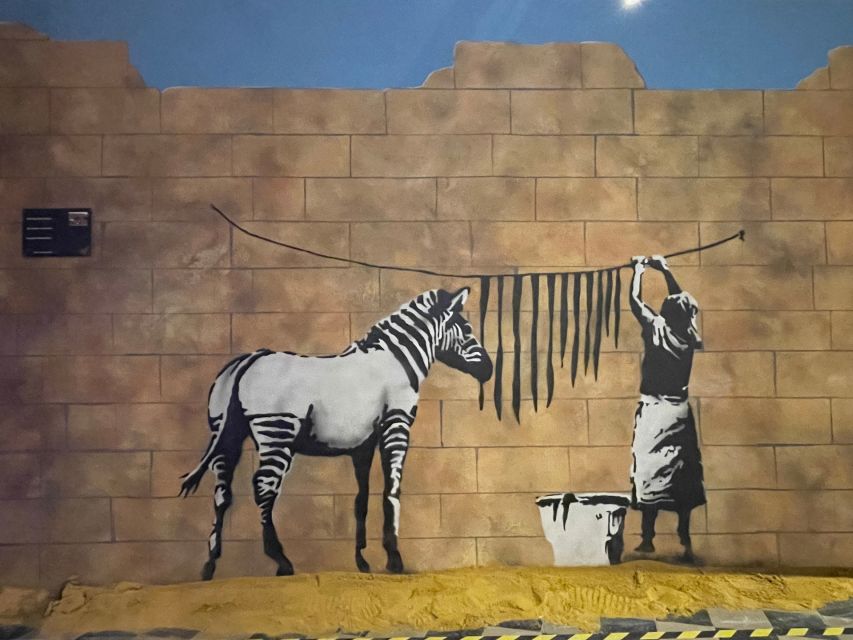
Banksy’s street art is made to be seen quickly, often before a wall is painted over or a building changes hands. This Brussels museum gives those disappearing works a second life, with more than 130 pieces and real-size murals arranged across a former fabric house near Place De Brouckère and Sainte-Catherine. I like the calm, self-guided format and the chance to study familiar images without being pushed along.
I also like the price. At about $16 per person, this is an easy addition to a day in central Brussels, especially if you enjoy modern art, political satire, or the mystery around Banksy himself. The main caution is that the displays are reproductions, not original street walls, and some pieces have only brief notes rather than a full explanation.
Key points at a glance
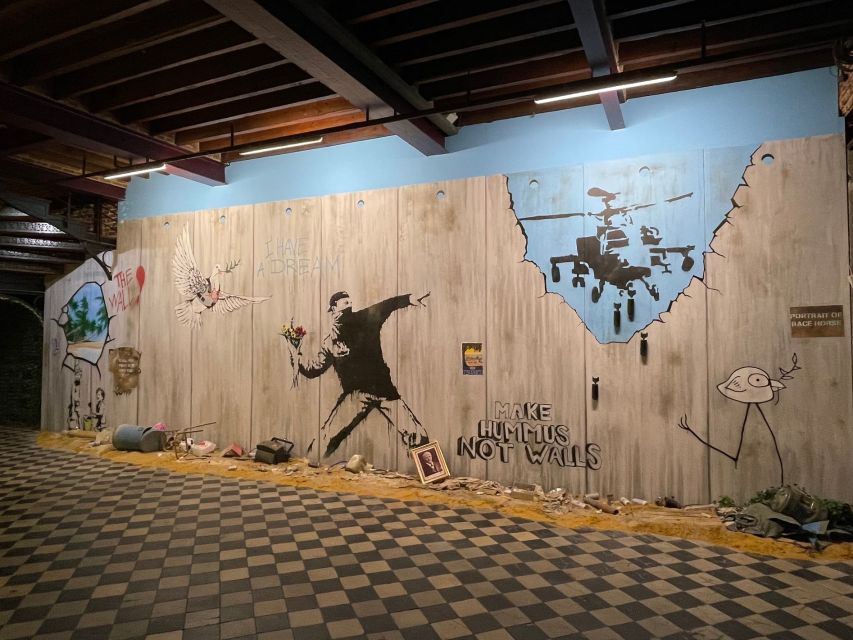
- More than 130 works: See a large collection of Banksy-inspired reproductions, stencils, and life-size murals in one place.
- A two-level former fabric house: The unusual setting adds atmosphere, though the upper floor may be a problem for wheelchair users because there is reportedly no lift.
- Self-guided and unhurried: Plan on about one hour, but allow up to two hours if you want to read the notes and take your time.
- Central Brussels location: The museum is near Place De Brouckère and Place Sainte-Catherine, useful when building a walking day around the city centre.
- Photos and video permitted: You can record the displays and spend time framing the murals without the pressure of a guided group.
- French, English, and Dutch support: Host or greeter assistance is available in these three languages.
The setting is part of the appeal. Instead of a bright, purpose-built gallery, the exhibition occupies the premises of a former fabric house in central Brussels. You move through an older building filled with large-scale street scenes, smaller works, and short pieces of background information.
That contrast suits Banksy. His art often turns ordinary walls, signs, and public spaces into something pointed. Here, the work is taken out of its original setting and placed indoors, but the rough, direct character remains part of the presentation.
The museum describes the exhibition as a way to bring together street creations that have vanished from their original locations. That matters because Banksy’s work is temporary by nature. A mural may be removed, damaged, painted over, or lost when a building is altered. Seeing a full-size recreation gives you a better sense of scale than a small image on a phone.
Still, you should know what you are buying. These are reproductions and recreations, not a collection of original walls personally brought in from around the world. That distinction is central to the experience, particularly for dedicated Banksy followers.
The exhibition covers more than 130 pieces, with the displays arranged over two levels. You are not given a strict tour route with a guide calling everyone together. Instead, you can move at your own speed, pause at a favourite image, or pass quickly through a work that does not speak to you.
I find this format especially useful for Banksy. His images are often simple at first glance, but the meaning can change when you stand with them for a few minutes. A short caption may identify the subject or offer a little context, while the image itself leaves room for you to form your own view.
The displays touch on major stages of Banksy’s artistic career and the ideas linked with his work. Expect political commentary, dark humour, anti-war themes, social criticism, and the tension between public art and commercial display. The tone is not presented as a formal art-history lecture. It is closer to a visual walk through his better-known street creations.
Some sections offer more explanation than others. That can be a plus if you prefer to think for yourself, but it may leave you wanting more background on individual works. If you like a detailed account of the origin, date, political setting, and later fate of every image, bring your own curiosity and plan to do extra reading afterward.
A phone screen flattens street art. A full-size mural lets you see the scale, spacing, and visual punch that make Banksy’s work effective in public places.
The life-size pieces are the strongest reason to visit rather than simply scrolling through images online. They help you understand how an image can dominate a wall and why its location is often part of the message. In the museum, you lose the original street setting, but you gain the chance to stand close, look carefully, and take a photo without traffic, weather, or a crowd getting in the way.
The presentation also lets you compare smaller works with large murals. That mix shows how Banksy’s ideas travel between quick stencil-like images and more detailed scenes. You can see recurring concerns and visual habits without needing to cross several countries to find the original sites.
There is a trade-off. Street art gains power from surprise and public access. Inside a ticketed museum, some of that edge is softened. I would approach this as a record of Banksy’s visual language, not as a substitute for finding an original work in its real setting.
The included visit is described as one hour, but the two-level layout means you can reasonably spend one to two hours inside. If you mainly want to see the headline pieces, an hour should be enough. If you read the information, stop for photographs, and look at each room closely, give yourself more time.
The atmosphere is quiet and relaxed. That makes the museum a useful break from a busy day in Brussels. You can take in the work alone, with a partner, or with friends without having to keep pace with a guide.
The self-guided approach also works well for people who know only the basics about Banksy. You can follow the broad story of his career, then pause when a particular image catches your eye. The information is presented in a fairly understated way, so the exhibition does not insist on one single interpretation of every piece.
This is not the place for a live talk or a long question-and-answer session with an art specialist. Host or greeter support is available in French, English, and Dutch, but the main visit is self-guided. If you want a formal lecture, this may feel light. If you like quiet time with the artwork, it is a good fit.
The biggest point to consider is the relationship between the museum and Banksy himself. The exhibition presents recreations of his work, but the supplied information does not say that Banksy approved the museum, took part in producing the displays, or receives royalties from them.
That does not make the exhibition worthless. It simply changes what you are seeing. You are viewing a presentation of Banksy’s public art, assembled to show the range and themes of his work. For many people, that is enough. The chance to see full-size versions in one central location has real value.
If you are deeply concerned with provenance, ownership, or official artist involvement, you may want to investigate those points before booking. The museum itself is better suited to someone who wants access to the imagery and ideas, rather than a formal archive of authenticated original objects.
I also appreciate that the exhibition does not appear to force a single interpretation. The work can be uncomfortable, and that is often intentional. You may find yourself laughing at one image and then thinking more seriously about the subject a moment later.
At around $16, the ticket is fairly easy to justify if you already plan to spend time in the city centre. You get access to a large number of works, full-size murals, and a visit that can fill an hour or two. That makes it more substantial than a quick pop-in attraction.
The value is strongest for three types of visitors:
- Someone who already likes Banksy and wants to see a broad selection in one place.
- Someone new to his work who wants an accessible introduction.
- Someone looking for a central indoor activity that does not require a full day.
The price is less attractive if your main goal is to see original Banksy works in their first locations. The museum cannot recreate the surprise, public setting, or local meaning of a street mural. You are paying for access, scale, and convenience.
Booking flexibility helps if your schedule is uncertain. You can reserve now and pay later, and cancellation is available up to 24 hours before the visit for a full refund. The ticket is valid for one day, with starting times shown according to availability.
The museum is near Place De Brouckère and Place Sainte-Catherine, two useful reference points in central Brussels. This makes it simple to pair with a day of city sightseeing rather than treating it as a separate out-of-town trip.
You could fit it around a walk through the historic centre, a meal near Sainte-Catherine, or other stops around the central squares. Because the visit takes about an hour for many people, it is not likely to take over your day.
The location also matters in poor weather. Brussels can be wet and grey, and this gives you an indoor stop with enough material to occupy more than a quick half-hour. I would use it as a planned break, not as the only activity on a full day.
The building itself may feel less polished than a traditional museum. One assessment described it as unappealing from the outside, though the exhibition inside was well laid out. That is useful to know: do not judge the experience by the exterior or expect a grand institutional entrance.
The exhibition is spread over two floors. A concern has been raised that there is no lift, which means the upper level may not be accessible to wheelchair users. If step-free access is important for you, confirm the current arrangement directly before booking rather than relying on a general accessibility label.
The visit is available with French, English, and Dutch host or greeter support. The presentation is mainly self-guided, so language support is useful for basic orientation, but you should not expect a long guided commentary in any of those languages.
Photography and video are allowed, which is a welcome feature for an art display built around striking visual images. The gift shop is another practical plus if you want Banksy-related items after the visit. One visitor found it especially appealing and bought several things, though shopping is an optional extra rather than part of the ticket.
For teachers, a student rate may be available. Check the booking choices carefully if you qualify, since that can lower the cost for an educational visit.
I would recommend the museum to fans of street art, visitors curious about Banksy’s ideas, and anyone who enjoys visual work with a political or social edge. It also suits people who prefer to set their own pace and do not want to join a fixed group.
Families with older children and teenagers may find plenty to discuss, though some themes can be uncomfortable. The museum is also a good solo stop because the quiet layout lets you focus without needing to match someone else’s pace.
Art specialists may find the captions too brief in places, and Banksy purists may be disappointed that the displays are reproductions. Someone hoping to meet the artist or see original works should not book for that reason. The experience is about access to a large selection of recreated street art and the chance to consider the ideas behind it.
Book it if you want an easy, central introduction to Banksy with more than 130 works, full-size murals, and enough freedom to look closely. At about $16, it offers solid value for an hour or two, especially on a rainy day or between central Brussels sights.
Think twice if authenticity, original locations, or official artist involvement are essential to you. Also check the two-floor layout if you need step-free access. For most casual art lovers and Banksy fans, though, this is a relaxed and worthwhile stop that gives you time to see the work without a rushed group schedule.
FAQ
More Museums in Brussels
- Brussels: Atomium Entry Ticket with Design Museum Ticket
★ 4.4 · 9,254 reviews - Choco-Story Brussels: Chocolate Museum Entrance with Tasting
★ 4.3 · 4,883 reviews - Brussels: 2.5-Hour Chocolate Museum Visit with Workshop
★ 4.6 · 1,263 reviews
How long does the Banksy Museum visit take?
The included visit is listed as one hour. You can spend up to one or two hours inside if you want to read the information and take your time across both floors.
How many works are on display?
The exhibition includes more than 130 pieces of art and real-size murals.
Is the visit guided?
The main experience is self-guided, allowing you to explore at your own pace. Host or greeter support is available in French, English, and Dutch.
More museums and galleries in Brussels:
- Brussels: Train World Museum Entrance Ticket
★ 4.7 · 524 reviews - Choco-Story: The Chocolate Museum in Brussels
★ 4.0 · 324 reviews - Brussels Train World Museum Entrance Ticket
★ 4.5 · 220 reviews - Brussels Autoworld Museum Entrance Ticket
★ 4.5 · 161 reviews
Where is the museum located?
It is in central Brussels, near Place De Brouckère and Place Sainte-Catherine.
Can I take photos and videos inside?
Yes. Photography and video are allowed during the visit.
Is the exhibition wheelchair accessible?
The exhibition is on two floors, and there is reportedly no lift. If you need step-free access, confirm the current arrangements before booking.
Just added around Brussels
- Standard vehicle from Brussels airport to city of Antwerp★ 5.0 · 4 reviews
- Luxury Minivan from Brussels airport to the city of Brussels★ 4.0 · 7 reviews
- Transfer Brussels Airport (BRU) –> City Center 7 PAX (ONE WAY)★ 5.0 · 7 reviews
- Luxury vehicle from Brussels airport to the city of Brussels★ 4.0 · 5 reviews
- Transfer Brussels Airport –> Brussels MB V Class 7 PAX (ONE WAY)★ 5.0 · 4 reviews
- Transfer Brussels Airport –> City MB E Class 1-3 PAX (ONE WAY)★ 5.0 · 6 reviews
- PRIVATE MPV TRANSFER FROM/TO BRUSSELS AIRPORT (Max 6 pax) ONE-WAY★ 5.0 · 4 reviews
- Waterloo Private Battlegrounds Tour with Lion Hill★ 4.5 · 9 reviews
Museums, compared.

Atomium Entry Ticket with Design Museum Ticket
Read our review →
Choco-Story Brussels: Chocolate Museum Entrance with Tasting
Read our review →
Choco-Story Chocolate Museum Guided Tour w/Tastings
Read our review →
2.5-Hour Chocolate Museum Visit with Workshop
Read our review →

Chocolate Making Workshop and Chocolate Museum Entry
Read our review →
Browse the lists this tour appears in