
Reviewed · CITY TOURS
Brussels: Private Tour of the Upper and Lower City
Brussels reveals itself in two layers on this private tour. The Lower City follows old river islands, grand squares, cafés, the opera house, and the Royal Galleries. The Upper City climbs toward the cathedral, royal park, museums, and the elegant Sablon district.
I like the clear split between these two parts, since it helps you understand how Brussels grew instead of seeing a blur of pretty buildings. I also like the private format, which lets you request an entertaining, academic, or professional style and ask about subjects such as Art Nouveau, Belgian beer, and chocolate.
The main catch is time. Three hours is enough for a strong introduction, but not enough to explore every museum or linger at every square. Museum tickets, food, drinks, and transport are not included, so plan for extra time and cost if you want to go inside.
Key points at a glance
- Two sides of Brussels: Trace the Lower City’s old river quarter, then climb through the Upper City toward the royal district and Sablon.
- Grand Place starts both sections: The tour uses Brussels’ central square as a useful anchor for understanding the city.
- A private guide for your group: The advertised price is $353 per group of up to 20, with groups limited to 25 participants.
- Eight guide languages: Choose from Spanish, Dutch, English, French, German, Italian, Russian, or Portuguese.
- Flexible subject matter: Ask for an entertaining, academic, or professional approach, with room to focus on architecture, museums, beer, or chocolate.
- Hotel pickup is possible: Transport during the tour is not included, but pickup from your Brussels hotel can be arranged.
Why the Lower City is the best place to begin
Brussels is easiest to understand from the bottom up. The Lower City grew around the Senne River and its old commercial quarters, while the Upper City developed around power, religion, government, and fine arts.
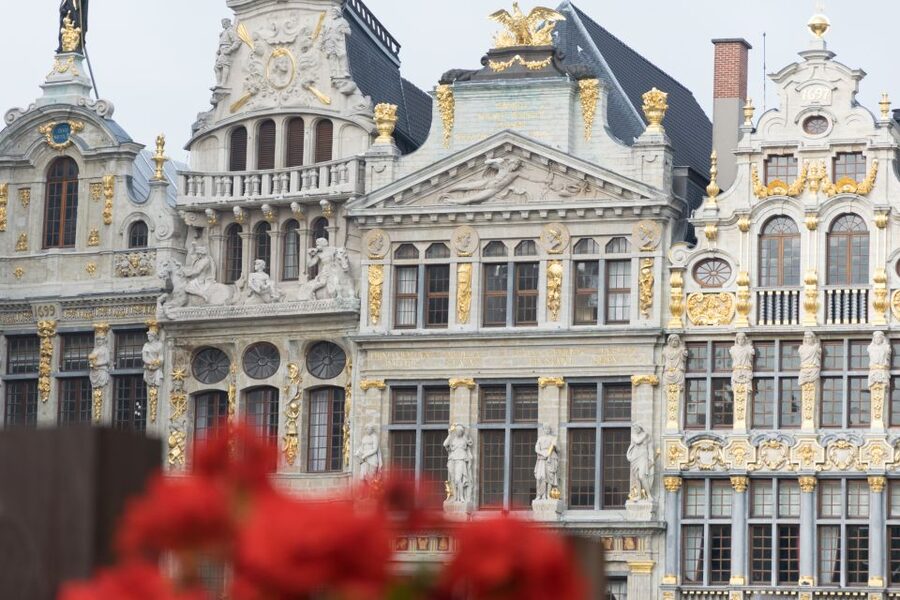
Your guide begins at Grand Place, the city’s central square. This is not simply a photo stop. It gives you a fixed point for the rest of the tour, since you return here before moving uphill into the Upper City.
Take time to look around before setting off. The square brings together the Gothic Town Hall, ornate guild buildings, and the Maison du Roi, with a strong sense of civic pride packed into a relatively small space. Your guide can explain how the square fits into Brussels’ development and why it remains the city’s main meeting point.
From here, the route heads to Manneken Pis. The small bronze boy is one of Brussels’ best-known symbols, though its modest size often surprises people. The stop works well because it shows a different side of the city: playful, informal, and happy to make fun of itself.
The sculpture is close to Grand Place, so you do not lose much time reaching it. Still, this is one place where expectations matter. Manneken Pis is a brief sight rather than a major monument. The value comes from the story and local character your guide adds, not from spending a long time looking at the statue.
More City Tours in Brussels
- From Brussels: Bruges & Ghent Day Tour – 2 Fairytale Cities
★ 4.7 · 8,242 reviews - Bruges and Ghent – Belgium’s Fairytale Cities – from Brussels
★ 4.0 · 4,809 reviews - Brussels: City Highlights Walking and Tasting Tour
★ 4.9 · 505 reviews
Saint-Géry and the old river quarter
The walk continues toward Saint-Géry island, once the largest island in the Senne River. This part of the route helps explain Brussels before its grand boulevards and monumental squares took shape.
You will not just be seeing isolated landmarks. The guide connects the old river setting with the city’s growth, trade, and changing street plan. That context matters because modern Brussels can otherwise feel like a collection of unrelated districts.
Saint-Géry also gives the Lower City a more local rhythm than the grand opening at Grand Place. You can ask your guide about how the river shaped the city and how the old center changed over time. If you enjoy urban history, this may be one of the more useful stops in the first half.
Next comes St. Catherine Square. Its setting near the former port area gives it a different mood from Grand Place, and it is a good place to notice how Brussels mixes older structures with later city development.
You then pass through De Brouckère Square and Monnaie Square. These spaces are larger and more formal, helping show the shift from medieval Brussels to a capital city with major public institutions and broad urban planning.
Monnaie Square is especially useful for understanding Brussels as a national capital. The federal opera house of Belgium is here, and your guide can place the building within the city’s cultural life. The route does not include an opera performance, so think of this as an exterior visit and an explanation of the building’s role.
The Royal Galleries and Brussels’ grand shopping tradition
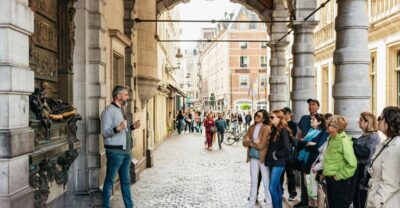
The Lower City section ends at the Saint-Hubert Royal Galleries, a set of glazed shopping arcades. Their covered passages make a pleasant change from the open squares and busy streets earlier in the walk.
The galleries are attractive, but they also tell you something about Brussels’ nineteenth-century ambitions. This was a city interested in polished public spaces, luxury shopping, and architecture designed to make commerce feel like a cultural outing.
You can browse the shops after the tour if you want a slower look. The guided visit itself is more about the architecture and the place in the city than about shopping. Keep that in mind if you are hoping for a tasting stop. Drinks, meals, chocolate, and beer are not included.
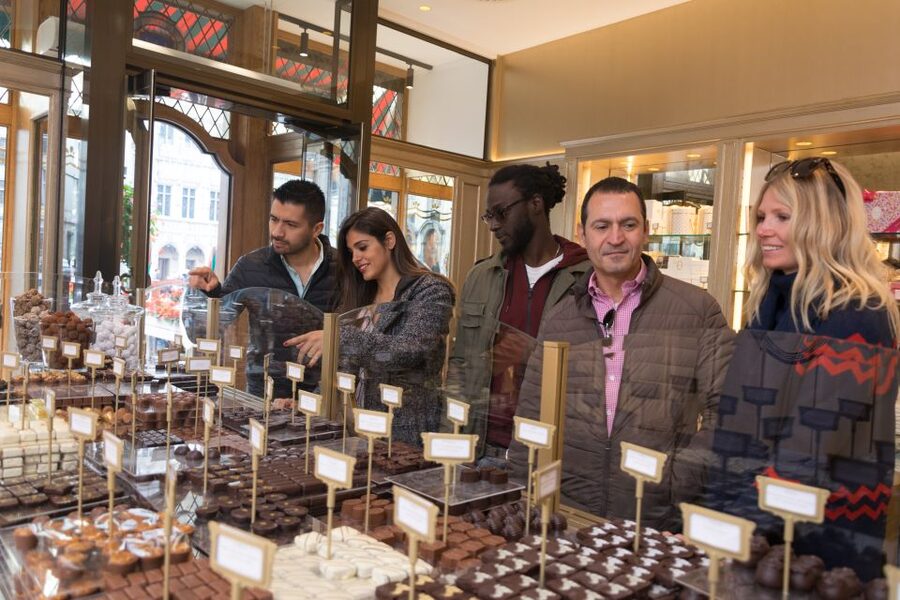
The tour’s focus on Belgian beer and chocolate is best understood as cultural background unless you arrange extra stops yourself. Your guide can discuss their place in Belgian life, but the supplied details do not promise tastings or purchases during the three hours.
Climbing toward the Upper City
The Upper City section begins at Grand Place again and moves uphill. This repeated starting point is practical. You get a clear transition between the two parts, rather than a long walk that tries to cover every district in one continuous route.
The first major stop is the Cathedral of St. Michael and St. Gudula. Inside, you can admire the stained-glass windows. This is one of the tour’s more important interior moments, since much of the rest of the route is based on outdoor sightseeing.
The cathedral gives you a chance to slow down and look upward. Your guide can help you notice the relationship between the building’s religious purpose, its Gothic design, and Brussels’ position as a major European capital.
Because the tour is only three hours, the cathedral visit will be an introduction rather than a detailed art-history lesson. If you want a long interior visit, let the guide know at the start. The itinerary can be adjusted to suit your needs, and that flexibility is one of the stronger reasons to choose a private tour.
From the cathedral, the walk continues toward Place des Palais. This takes you into the royal part of Brussels, with the royal park and palace nearby.
The contrast is clear. The Lower City route shows old commercial streets and public squares, while the Upper City presents formal avenues, government buildings, royal spaces, and major museums. Seeing both gives you a better sense of Brussels than spending the entire morning around Grand Place.
A few more Brussels half days worth weighing up
- Brussels: Atomium Entry Ticket with Design Museum Ticket
★ 4.4 · 9,254 reviews - From Brussels: Guided Day Trip to Bruges and Ghent
★ 4.6 · 8,353 reviews - Choco-Story Brussels: Chocolate Museum Entrance with Tasting
★ 4.3 · 4,883 reviews - Brussels: Hop-On Hop-Off Bus Tour
★ 4.0 · 4,016 reviews
Museums, Magritte, and the Sablon
The Upper City route offers a choice between the Musical Instruments Museum and passing by the Magritte Museum and the Palace of Fine Arts. The exact choice should be discussed with your guide, since the tour cannot give you a full visit to every museum in the time available.
The Musical Instruments Museum is particularly suited to travelers who want a museum stop with a strong connection to Belgian culture. If you choose it, remember that museum tickets are not included. You should also allow for the fact that entering a museum uses part of the three-hour schedule.
Alternatively, you may pass by the Magritte Museum and the Palace of Fine Arts. This option keeps the tour moving and gives you a wider view of Brussels’ cultural district, but it does not replace a proper museum visit.
That choice is a useful example of the tour’s strength and limitation. You get a guide who can adapt the route, but flexibility cannot create extra hours. If your priority is art, tell the guide before the walk begins. If your priority is seeing as much of the city center as possible, staying outside may suit you better.
The tour finishes around Petit Sablon and Grand Sablon. These squares are among the most attractive spaces in the Upper City, with a more refined feel than the Lower City’s commercial streets.
Petit Sablon is a good place to finish because it brings together gardens, sculpture, and architectural detail in a compact setting. Grand Sablon adds elegant buildings, shops, and a strong connection to Brussels’ artistic and chocolate traditions.
You may find the ending more relaxed than the opening. There is room to continue exploring on your own, look for chocolate shops, or use the Sablon as a starting point for another museum visit. The guide’s formal portion ends here, so any further exploration is your own time.
How the private format changes the experience
The price is $353 per group, advertised for up to 20 people. That is a high total for one or two people, but the value improves sharply if you are sharing it with family, friends, or a larger private party.
A private format matters most when your group has different interests. One person may want architecture, another may care about Belgian chocolate, and someone else may prefer museums or political history. The guide can set an entertaining, academic, or professional tone rather than forcing everyone into the same standard presentation.
The stated group limit is slightly unusual: the price covers up to 20 people, while group information says tours are limited to 25 participants. Confirm the exact maximum and price arrangement when booking if your party has more than 20 people.
You also get a live guide in English, French, Dutch, German, Spanish, Italian, Russian, or Portuguese. This wide language choice is useful for mixed-language families and work groups. Guide quality can shape the experience, and two named guides connected with the bookings were Emil and Mr. Boeykens. Emil was praised for keeping a good balance between different periods of the city’s development, while Mr. Boeykens was remembered as friendly and energetic even in cold, unpleasant weather.
Those details point to something practical: ask for the language and tone you want, and tell the guide what your group already knows. A private walk works best when the conversation is shaped around your needs.
Timing, walking, and extra costs
The stated duration is three hours. That makes this a brisk city orientation, not a full-day cultural program. You will cover many districts and landmarks, so comfortable walking shoes are sensible, particularly because the route moves from the Lower City uphill toward the Upper City.
The schedule describes the Lower City first and the Upper City later in the day. Since the listed duration is three hours, confirm the exact starting time and how the two sections are arranged when you book. The available starting times can change.
Hotel pickup is possible from your Brussels hotel, which saves you the trouble of finding the meeting point. Transport itself is not included, so do not expect a vehicle to carry you between stops. The experience is built around walking through the historic center.
Museum admission is extra. Meals and drinks are also extra, and no beer or chocolate tasting is promised. If those are priorities, ask your guide if the route can include suitable free time, but do not assume the cost is part of the booking.
The tour is wheelchair accessible. Because the route includes an uphill section and several historic streets, it is still wise to discuss your exact needs before the tour begins. The information confirms accessibility, but it does not describe the surface or access details at every stop.
Free cancellation is available up to 24 hours before the tour for a full refund. You can also reserve and pay later, which is helpful when your Brussels schedule is still shifting. Availability can remain open until two hours before the start, but popular times may fill earlier.
Who will get the most from this Brussels walk
I would choose this tour for a first visit when you want a quick but thoughtful introduction to central Brussels. The Lower City and Upper City structure gives you a useful mental map, and the private guide can answer questions that a standard group walk may not cover.
It also suits families and larger groups who prefer to stay together. A private booking is easier to justify when the cost is shared among several people, especially if you value hotel pickup and a chosen language.
Art lovers should decide early between the Musical Instruments Museum and the route past the Magritte Museum and Palace of Fine Arts. Museum fans may find three hours too short if they want serious time inside. Chocolate and beer enthusiasts should treat those subjects as themes for discussion, not included tastings.
The tour may be less suitable if you want a slow food experience, extensive museum time, or a deep architectural study of every building. You will see a broad range of places, but the pace has to remain steady.
Should you book this private Brussels tour?
Book it if you want the city explained through its geography and development, not just a list of photo stops. The best features are the two-part route, the private guide, the choice of language and tone, and the chance to connect Brussels architecture with beer, chocolate, museums, and royal history.
Before paying, make two points clear: how your three hours will be divided between the Lower and Upper City, and which museum option you prefer. If your group is large enough to share the $353 price, the value becomes much stronger. For a small group wanting a relaxed, museum-heavy day, a shorter private walk followed by independent visits may be the better plan.
FAQ
How long is the Brussels private tour?
The tour lasts three hours.
What parts of Brussels does the tour cover?
It covers the Lower City and Upper City, including Grand Place, Manneken Pis, Saint-Géry island, St. Catherine Square, De Brouckère Square, Monnaie Square, the federal opera house, the Saint-Hubert Royal Galleries, the Cathedral of St. Michael and St. Gudula, Place des Palais, the royal park and palace, the museum district, Petit Sablon, and Grand Sablon.
Is the tour private?
Yes. It is offered as a private group experience.
How many people can join?
The price is listed for a group of up to 20 people. The group information also says tours are limited to 25 participants, so confirm the exact arrangement if your party is larger than 20.
Which languages are available?
Guides are available in Spanish, Dutch, English, French, German, Italian, Russian, and Portuguese.
Are museum tickets, food, and drinks included?
No. Museum tickets, transport, meals, and drinks are not included.
Can the tour start from my hotel?
Pickup is possible from your Brussels hotel. Transport during the tour is not included.
Just added around Brussels
- Standard vehicle from Brussels airport to city of Antwerp★ 5.0 · 4 reviews
- Luxury Minivan from Brussels airport to the city of Brussels★ 4.0 · 7 reviews
- Transfer Brussels Airport (BRU) –> City Center 7 PAX (ONE WAY)★ 5.0 · 7 reviews
- Luxury vehicle from Brussels airport to the city of Brussels★ 4.0 · 5 reviews
- Transfer Brussels Airport –> Brussels MB V Class 7 PAX (ONE WAY)★ 5.0 · 4 reviews
- Transfer Brussels Airport –> City MB E Class 1-3 PAX (ONE WAY)★ 5.0 · 6 reviews
- PRIVATE MPV TRANSFER FROM/TO BRUSSELS AIRPORT (Max 6 pax) ONE-WAY★ 5.0 · 4 reviews
- Waterloo Private Battlegrounds Tour with Lion Hill★ 4.5 · 9 reviews
City Tours, compared.


Bruges and Ghent – Belgium’s Fairytale Cities – from Brussels
Read our review →
Browse the lists this tour appears in