
Reviewed · CITY TOURS
Ghent Walking Tour – City Highlights and Beyond Tradition
Ghent reveals itself best on foot, and this small-group walking tour gives you a useful first look without making you wrestle with a map. In about 90 to 105 minutes, you move from the old Friday Market to Gravensteen, the three medieval towers, and the handsome quays of Graslei and Korenlei.
I like the group size of up to 10 people, which gives a guide room to answer questions and adjust the walk. I also like the mix of famous sights, street art, and less obvious streets that you might pass by on your own. The main catch is the pace: you need to walk at least 5 kilometers, and the non-refundable $67.10 price is a serious commitment for a short tour.
Key points to know before you book
- Vrijdagmarkt starts the story: You begin beside the Artevelde statue in a historic square surrounded by notable houses and old streets.
- The route covers Ghent’s big three towers: Saint Nicholas Church, the Belfry, and Saint Bavo Cathedral can be viewed together.
- Gravensteen comes with a neighborhood bonus: The castle stop also brings you around Patershol, one of the city’s especially atmospheric areas.
- A small group makes a difference: The tour is capped at 10 people, though the included details also describe a possible range of 1 to 12.
- You need proper walking shoes: The route requires at least 5 kilometers of walking, with photo stops along the way.
- The guide can shape the outing: The route may be adapted to suit the interests of the group, which is useful when families or first-time visitors join.
Why this walk is a smart first look at Ghent
Ghent can feel confusing at first because its major sights are spread across several historic areas. A short guided walk helps you connect them. Instead of seeing a castle in one direction, a church in another, and a pretty canal without context, you get a basic map of the old center and an explanation of how the pieces fit together.
The appeal here is not a long museum visit or a single grand monument. It is the range. In one outing, you see a market square, medieval defensive architecture, a former trading center, street art, churches, and streets that are less obvious on a standard sightseeing route.
That makes this tour especially useful at the start of a stay. Afterward, you can return to the places that caught your eye, spend more time inside the castle or cathedral if you choose, or use the guide’s suggestions to shape the rest of your day.
The experience lasts roughly 1 hour 30 minutes to 1 hour 45 minutes. That is long enough to orient yourself, but short enough to fit around lunch, a museum visit, or an afternoon train. You are paying $67.10 per person, so I would not book it simply to collect a few quick photographs. The value comes from having a local person connect the sights and point out places you might miss.
More City Tours in Ghent
- Ghent: 40-Minute Historical Boat Tour of City Center
★ 4.3 · 430 reviews - Ghent: Guided City Tour with Food Tastings
★ 4.8 · 228 reviews - Ghent: City Highlights and Hidden Gems Guided Bike Tour
★ 4.7 · 196 reviews
Beginning at Vrijdagmarkt and the Artevelde statue
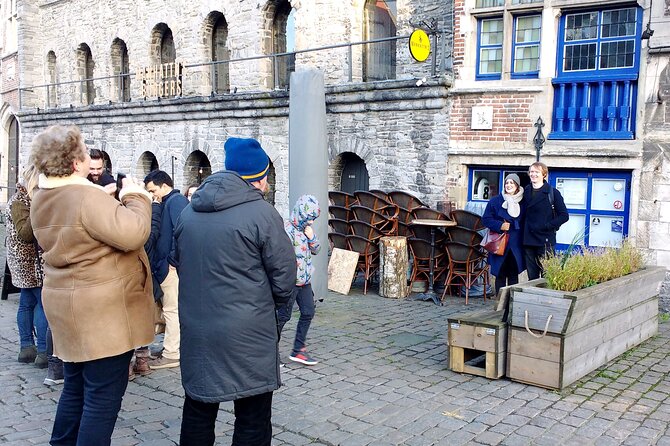
The walk begins at the Artevelde statue in Vrijdagmarkt, or Friday Market. This is a useful starting point because the square gives the guide room to introduce Ghent before the group heads into tighter streets.
Expect a brief explanation of the square, its surrounding houses, and the plan for the walk. You can also ask about the route at this point, especially if your group has a particular interest in architecture, old neighborhoods, street art, or the city’s history.
Vrijdagmarkt is more than a meeting point. Its buildings and open shape give you an early sense of Ghent’s past as a place of trade and public life. The nearby streets then lead you into a denser part of the old center.
The first stop is listed as about 10 minutes, though the full walk continues through several connected areas. Photo stops are built in, so you are not expected to march without looking around. Still, this is a walking tour, not a leisurely café crawl. Wear comfortable shoes and keep your camera ready rather than stopping for long personal photo sessions.
Gravensteen and the streets around Patershol
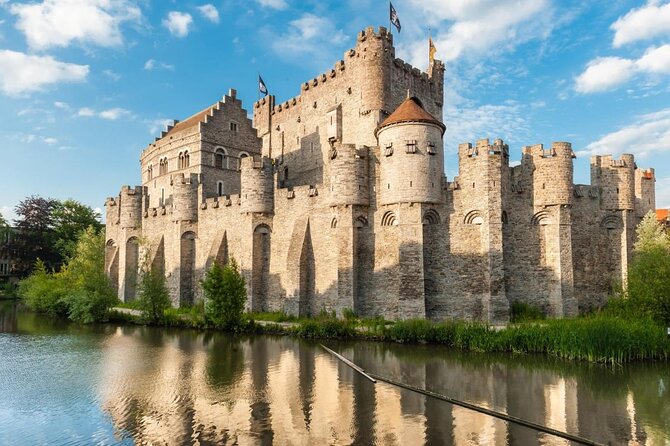
From Friday Market, the guide takes you toward the Castle of the Counts, known as Gravensteen. The castle gives the route a strong visual centerpiece: medieval walls, a clear defensive purpose, and plenty of stories for a guide to explain.
The tour focuses on the surrounding areas as well as the castle itself. That matters because the outside setting helps you understand how the castle fits into the older city. You see more than a single building viewed from a distance.
Patershol is part of this section. Its narrow historic streets offer a change from the open market square and help show how Ghent’s character shifts from one neighborhood to another. This is also the kind of area that is easy to pass through without knowing what you are seeing, so a guide’s comments can add real value.
Do not assume that this walking tour includes a full interior visit to Gravensteen. The information provided describes the guide taking you to the castle and surrounding areas, not an included castle admission or extended visit inside. If entering the castle is a priority, plan that separately and allow extra time.
The guide may adapt the route to the interests of the group. That is helpful here. Someone interested in medieval buildings may want more context around the castle, while a family may prefer a quicker explanation and more time moving through the streets. Sophie, one of the guides, contacted a family after booking to ask if children would join, then adjusted her approach to suit the group. That kind of preparation is a useful sign for families considering the walk.
The three medieval towers in one view
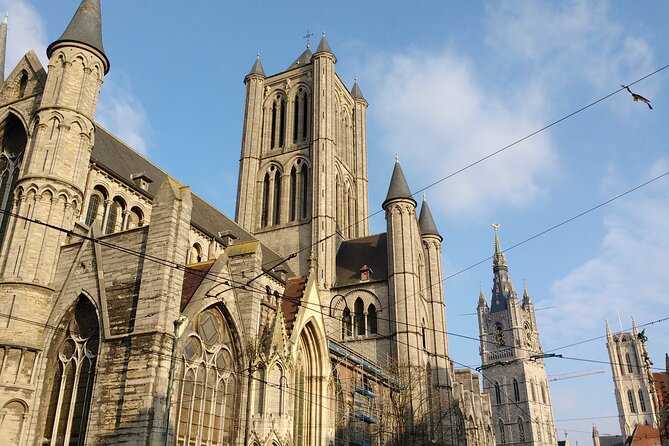
The next major section brings you to Ghent’s famous trio: Saint Nicholas Church, the Ghent Belfry, and Saint Bavo Cathedral. You can see all three medieval towers together, which gives you one of the clearest visual explanations of the old city’s center.
This is one of the strongest parts of the tour for first-time visitors. Rather than treating each church as a separate stop, the guide shows you their relationship. You get a better sense of the city’s historic core and can decide which building deserves a closer look later.
The Belfry is one of the oldest in Belgium, and its presence is hard to miss. Saint Nicholas Church and Saint Bavo Cathedral complete the group, creating a memorable line of towers across the center. The tour does not list interior admissions, so you should think of this as an exterior sightseeing and orientation stop.
That limitation is worth noting. If your main goal is to climb the Belfry, examine cathedral art, or spend time inside the churches, this tour will only provide the introduction. Its job is to show you the landmarks, explain their place in Ghent, and keep you moving through the city.
The advantage is efficiency. In a short span, you gain a visual reference for three major sights and learn where they sit in relation to one another. That can save time later, especially if you are visiting Ghent for only a day.
More Walking Tours in Ghent
- Historical Walking Tour: Legends of Gent
★ 5.0 · 1,761 reviews - Ghent: Belgian Chocolate Walking Tour with Tastings
★ 4.9 · 259 reviews - Gastronomic Walking Tour of Gent – Tasters included
★ 5.0 · 199 reviews - Ghent: Private 2-Hour Walking Tour
★ 4.7 · 134 reviews
Graslei and Korenlei, where trade became café life
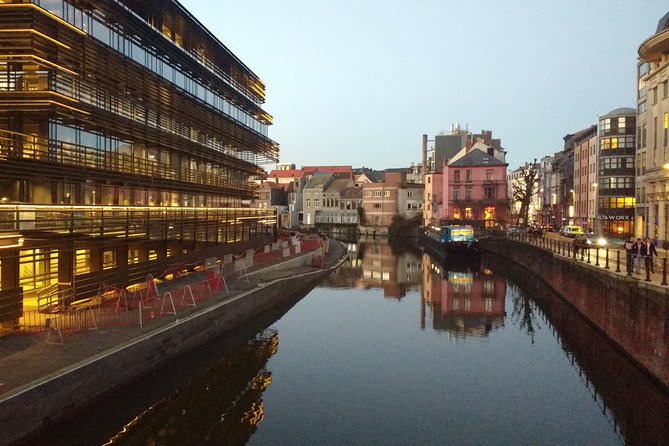
The route also reaches Graslei and Korenlei, Ghent’s best-known quays. These waterfront streets were linked to medieval trade and are now lined with cafés and restaurants.
This is a natural place for the tour to slow down. The quays offer attractive views, historic façades, and a change of mood after the inland streets and castle area. You can take photographs, watch the water, and make a note of a café or restaurant for later.
The stop is listed as about 10 minutes. That is enough for an introduction and pictures, but not enough for a full meal or a long break. If you want to sit by the water, plan to return after the tour.
The quays also show why a local guide can be useful. Without context, you may simply see a pretty waterfront lined with old buildings. With an explanation of its role in medieval trade, the scene has more meaning. You begin to see Ghent as a working commercial city, not just a collection of photogenic façades.
Street art, local corners, and a route that can change
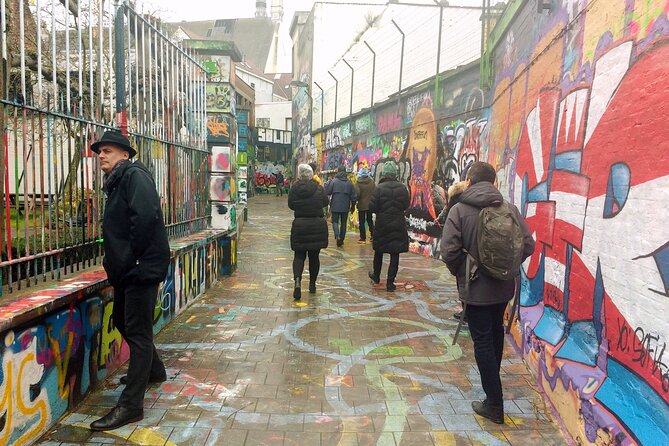
The experience includes both well-known sightseeing spots and less expected places, including street art and corners that locals enjoy. The supplied route lists the main landmarks, but it is described as an example rather than a rigid promise of every turn.
That flexibility can work in your favor. A guide who knows the city may spend more time in an area that fits your interests, point out a local favorite, or shorten a section that does not appeal to your group. Sophie was praised for showing streets and neighborhoods a family would not have found on its own. Her enthusiasm for Ghent also came through clearly.
At the same time, flexibility means you should not expect a precise checklist. If one particular mural, alley, or building is your top priority, ask about it at the beginning. The guide can then tell you if it fits the route.
This approach suits people who want a sense of the city rather than a formal lecture. You get history, but you also get the modern city and the ordinary streets between the major monuments.
Small groups, pace, and family considerations
The group is capped at 10 travelers according to the tour details, while the included information also describes small groups of 1 to 12 people. Because those figures do not match perfectly, I would treat 10 as the stated maximum and confirm the exact group size when booking.
A small group usually makes a walking tour easier to manage. You can hear the guide more clearly, ask questions without holding up a large crowd, and benefit from route changes when appropriate. It also makes photo stops less awkward.
The physical requirement is clear: you should be able to walk at least 5 kilometers at a moderate pace. The route includes stops, but it is not designed for someone who needs frequent long rests.
Children must keep up with the pace of the slowest adult in the group. If that will not work for your family, ask about a private option before booking. Sophie’s effort to find out about children in advance is encouraging, but the pace requirement still applies.
The tour does not include transport. It begins at Vrijdagmarkt, near public transportation, and may finish on another side of the city. You can walk back or take a bus or tram, so allow a little time to find your bearings at the end.
What the $67.10 price really buys you
At $67.10 per person, this is not the cheapest way to see Ghent’s center. You can walk between many of these sights on your own at no admission cost. The price makes more sense if you value a planned route, local stories, group interaction, and help noticing places you might otherwise overlook.
The small group is the key value. A large city tour can feel like following a flag through streets. With up to 10 people, the guide has more room to respond to questions and adjust the focus.
The price does not include transport or listed admission to paid attractions. You are paying for the local guide, the sightseeing route, historical context, and the work involved in planning the walk. That is worthwhile for a first visit, especially if you have limited time.
I would skip it if you already know Ghent well, prefer exploring alone, or only want entrance visits to the Belfry, churches, or Gravensteen. You could spend the same money on admissions, food, or another activity that better matches your style.
Practical details that affect your decision
Confirmation is sent within 48 hours of booking, subject to availability. The tour is non-refundable and cannot be changed for any reason, so book only when your schedule is firm.
You should be in moderate physical condition and wear good walking shoes. The provider does not accept people who are ill with symptoms such as coughing or sneezing.
The tour is offered with a mobile ticket, and the meeting point is Vrijdagmarkt, 9000 Ghent, Belgium. Since the ending point may be on another side of the city, avoid scheduling a tight connection immediately afterward.
The activity is generally booked about 20 days in advance. That does not guarantee that every date will sell out, but it suggests you should not leave planning until the last minute if your Ghent visit is fixed.
Who should book this Ghent walk?
I would choose this tour for a first-time visitor who wants a quick city orientation with more personality than a self-guided route. It also suits couples, friends, and families who can comfortably walk 5 kilometers and appreciate a guide who can adjust the emphasis.
It is a good fit if you want to see Gravensteen, the old quays, the medieval towers, Friday Market, Patershol, and some modern street art in one outing. It is less suitable if you need a slow pace, want extensive time inside monuments, or prefer a completely fixed sightseeing schedule.
Should you book it?
Book this walking tour if you want a compact introduction to Ghent led by a local, especially at the start of your stay. The combination of major landmarks, Patershol, street art, and local streets gives you a useful first map of the city.
The strongest reasons to go are the small group, the adaptable route, and guides such as Sophie, who take the time to understand who is in the group. The main reasons to hesitate are the high per-person price, the 5-kilometer walking requirement, and the strict cancellation terms.
If those points work for you, this is a practical way to get your bearings and choose what deserves more of your time afterward.
FAQ
Where does the Ghent walking tour begin?
It begins at the Artevelde statue in Vrijdagmarkt, 9000 Ghent, Belgium.
How long does the tour last?
The tour lasts approximately 1 hour 30 minutes to 1 hour 45 minutes.
How far do I need to walk?
You need to be able to walk at least 5 kilometers. The tour includes stops for photographs.
What landmarks are included?
The route includes Vrijdagmarkt, the Castle of the Counts, the surrounding Patershol area, the Ghent Belfry, Saint Nicholas Church, Saint Bavo Cathedral, Graslei, and Korenlei. Street art and other local areas may also be included.
How many people can join the tour?
The stated maximum is 10 travelers. The included information also refers to small groups of 1 to 12 people, so you may wish to confirm the exact group size when booking.
Does the tour include transportation or admission tickets?
No. Transportation and admission tickets are not included. The tour begins near public transportation, and the ending point may be elsewhere in the city, where you can walk back or take a bus or tram.
Just added around Ghent
- Historic Highlights, by a local guide★ 5.0 · 9 reviews
- Discover Ghent while playing! Escape game – The alchemist★ 4.0 · 4 reviews
- Walking Food Tour in Ghent★ 5.0 · 13 reviews
- Discover Ghent while playing! Escape game – The Walter case★ 4.5 · 4 reviews
- Discover Ghent with a self-guided Outside Escape city game tour!★ 4.0 · 10 reviews
- Ghent Walking Tour with Audioguide on Your Smartphone★ 4.5 · 13 reviews
- e-Scavenger hunt Kortrijk: Explore the city at your own pace★ 4.5 · 15 reviews
- Private Ghent Beer & Brewery Tour by a young local★ 5.0 · 12 reviews
City Tours, compared.


Bruges and Ghent – Belgium’s Fairytale Cities – from Brussels
Read our review →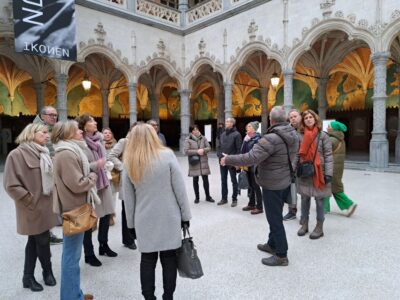


Browse the lists this tour appears in