
Reviewed · DARK SIDE & LEGENDS TOURS
Historical Walking Tour: Legends of Bruges
Bruges reveals itself best at walking speed, when a bell tower, canal, brewery, and crooked old house arrive one after another. This tour links the city’s big sights with the stories behind them, from medieval trade at Markt to the swans of Minnewater Lake and the beer pipeline beneath the streets. I especially like the strong two-hour route and the way it covers famous landmarks without charging a standard admission fee.
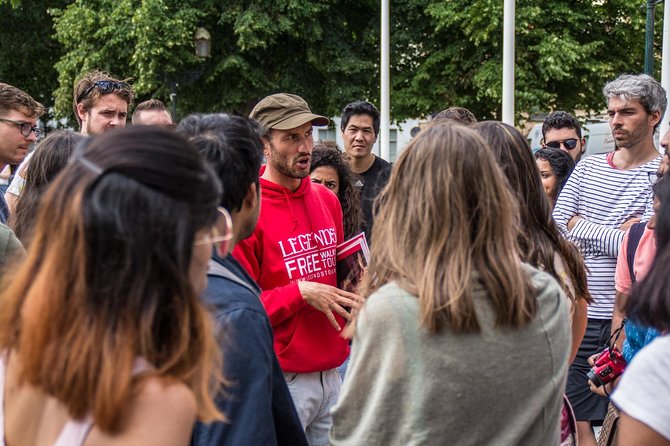
I also like the human touch. Guides such as Louis, Victoria, Martin, Sander, Wouter, and Thomas have been praised for humor, clear English, visual aids, and practical suggestions for food and shopping. The trade-off is that the tour stays outdoors for much of its length, and one report describes a guide failing to appear. Cold or wet weather can also make the long walk harder.
Key points about the Legends of Bruges walk
- Eleven major stops in about 2 hours 15 minutes, beginning at Markt and ending at Burg Square.
- Stories, not just sightseeing, including Bruges’ quarrels with French kings, Emperor Maximilian, and the origin of the Fools of Bruges nickname.
- Free-priced format with tips expected, making it one of the least expensive ways to get an organized introduction to Bruges.
- A maximum of 24 people, though some departures may be smaller and allow more questions.
- English-speaking guides with different styles, including Louis, Victoria, Martin, Sander, Wouter, and Thomas.
- A useful first-day orientation, with suggestions for chocolate, restaurants, shopping, and sights to revisit.
Why this Bruges walking tour works so well
The route is smart. It does not trap you in one square or spend two hours on a single church. Instead, it gives you a broad first look at Bruges, covering the medieval center, southern canals, major churches, old commercial quarters, and political heart.
I would use it early in a Bruges visit. After the walk, the city’s famous sights have a story attached to them, and you can decide which places deserve a slower second visit. The route ends at Burg Square, so you are well placed to continue sightseeing on your own.
The tour lasts about 2 hours 15 minutes, with stops generally lasting between five and 15 minutes. That pace keeps the walk moving, but it also means you should not expect long interior visits. The guide explains the Belfort from the halls behind the belfry, pauses outside De Halve Maan Brewery, and visits the garden of the Groeningemuseum rather than presenting this as a full museum tour.
The price is listed at $3.62 per person, with fees and taxes included. That is excellent value for an organized introduction, but remember that the low price depends on gratuities. A guide who spends more than two hours walking, answering questions, and telling local stories deserves a proper tip if the experience works for you.
More Dark Side Tours in Bruges
- Evening Tour: The Dark Side of Bruges
★ 5.0 · 956 reviews - Historical Walking Tour: The Story of Bruges – by Legends
★ 4.7 · 483 reviews - Bruges at Night: Murder, Mystery & Dark Stories Small Group Walk
★ 5.0 · 137 reviews
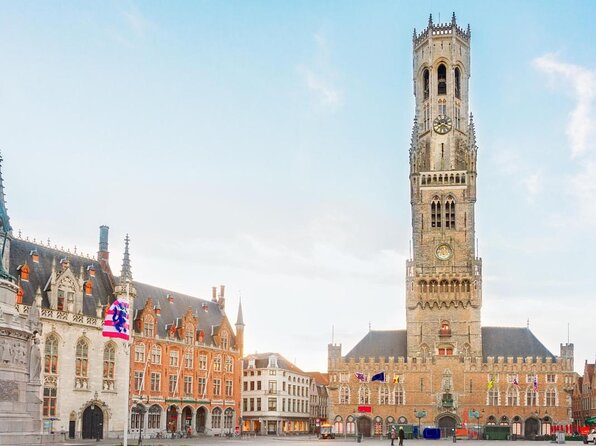
Markt sets up Bruges’ medieval power
The tour begins at Pieter de Coninck en Jan Breydel Markt, Bruges’ grand central square. This is the right place to start because the city’s wealth, politics, and public life all meet here.
You hear how Bruges became a trading hub during the Middle Ages. The guide also explains the difficult relationship between Bruges and the French king, a useful reminder that this was not simply a pretty merchant town. It was a city with money, influence, and enough political confidence to cause trouble.
The 15-minute stop gives you a clear frame for the rest of the walk. Look up at the surrounding buildings, then listen for the connection between commerce and power. The square can be busy, so stay close to the guide and make sure you can hear before the story begins.
Belfort explains the city’s watchful tower
The Belfort is one of Bruges’ defining sights, but this tour focuses on its role rather than sending you up the tower. You visit the halls behind the belfry and learn how the tower mattered during the Middle Ages.
That distinction is important. If you want the climb and the view from the top, you need to arrange a separate ticket. One useful tip from the tour experience is to buy tower tickets in the morning, since access can become harder later in the day.
The 10-minute stop is short, but it gives the tower meaning. You are not just looking at a tall medieval structure. You are hearing how it fit into the city’s public life and defense.
Gruuthusemuseum reveals the money behind beer
The Gruuthusemuseum occupies a renovated city palace once owned by a wealthy Bruges family. The family held a monopoly on a specific part of the beer trade, and that detail gives the stop a sharper edge than a simple architectural description.
Here, I like the connection between a grand residence and an ordinary drink. Beer was not merely a refreshment. Control of its trade could help make a family powerful enough to live in a palace.
The stop lasts about 10 minutes. Treat it as an introduction to the building and its owners, not a substitute for visiting the museum galleries. The guide’s explanation can help you decide if you want to return later for a longer look.
More Historical Tours in Bruges
- THE Storytelling Tour of Bruges | First Day Must | History & Tips
★ 5.0 · 925 reviews - 💛 Tell Me About Bruges 🏰 1000 Years of Stories by Locals ⭐
★ 4.9 · 528 reviews - Private Historical Tour: The Highlights of Bruges
★ 5.0 · 315 reviews - 2-Hour Historical Walking Tour in Bruges with Praline Included
★ 5.0 · 291 reviews
Sint-Janshospitaal puts medieval care in context
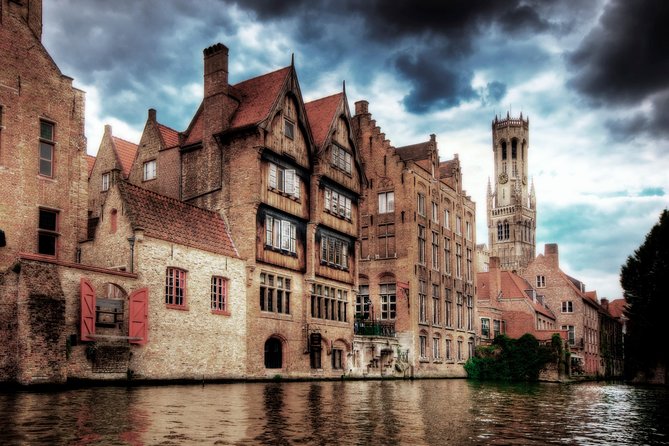
Sint-Janshospitaal is one of the oldest surviving hospitals in the world and a key part of medieval society. The 10-minute stop shows you a side of Bruges that is easy to miss when you focus only on canals and decorated facades.
A hospital in the medieval city was not just a medical facility in the modern sense. It was part of the network of religious, charitable, and civic institutions that helped hold urban life together. The guide places the building within that wider setting.
This is another stop where the tour provides a useful first look. If you want art, architecture, or a longer visit inside, plan to return separately. The walking tour gives you the reason to care before you spend more time there.
The Beguinage offers a quieter stretch

The Princely Beguinage Ten Wijngaarde brings a change of mood. You walk into a picturesque enclosed community where women have lived together for more than 800 years.
The setting matters as much as the story. After the open squares and major monuments, the beguinage feels calmer and more private. Keep your voice low and follow the guide’s lead, since this is a place where respect matters more than rushing around for photographs.
The tour describes it as the largest beguinage of its kind in the world. The 10-minute stop is enough to understand the community’s long life and distinctive place in Bruges, though you may want additional time here if the atmosphere appeals to you.
De Halve Maan connects beer with city pride
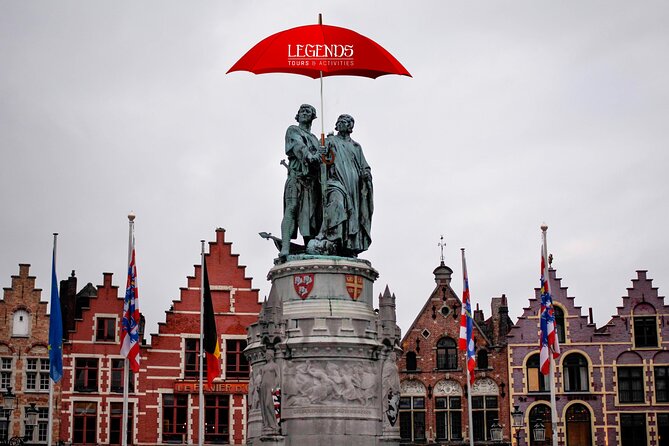
At De Halve Maan Brewery, the guide explains why Bruges’ people acquired the nickname Fools of Bruges. You also see a piece of the beer pipeline running beneath the city.
This is one of the route’s most memorable local details because it connects an old brewery to modern city infrastructure. It also gives the walk a touch of humor after the more formal stories about churches, kings, and hospitals.
The stop is outside the brewery, so do not confuse it with a brewery tour or tasting. If beer is a major reason you are in Bruges, you can treat this pause as a prompt to return for a separate visit.
Minnewater Lake brings in swans and emperors
At Minnewater Lake, the guide tells the story behind Bruges’ swans and the city’s conflict with Emperor Maximilian of Austria. This is exactly the kind of tale that makes a walk more useful than a route map. You see an attractive place, then learn why its symbols and stories matter.
The 15-minute stop is one of the longer pauses on the tour. It gives you time to take in the water and hear the political story without feeling hurried.
The lake also provides a change from the dense medieval center. If the walk has felt packed with buildings and facts, this is a welcome open-air pause.
Onze-Lieve-Vrouwekerk brings art and dynastic power together
The Church of Our Lady is famous for its brick tower, described as the second tallest brick tower in the world. It also houses a Michelangelo statue and the tombs of the last Dukes of Burgundy.
That is a lot of significance in one 10-minute stop. The church links architecture, art, and dynastic history in a way that helps explain Bruges’ former importance. You get a sense of how religious buildings also served as places of memory and political display.
The tour does not present this as a full church visit. If seeing the Michelangelo statue or tombs is a priority, check how much independent time you have after the walk.
Groeningemuseum gives you a taste of Flemish art
The guide takes you into the garden of the Groeningemuseum, where works by major Flemish masters are on display. With only five minutes allocated here, this is a quick orientation rather than an art lesson.
Still, the stop earns its place. Bruges is closely tied to the Flemish painting tradition, and the garden offers a pause to connect the city’s buildings with its artistic past. You can decide later if the museum deserves a longer visit.
This is also a good example of the tour’s limits. Eleven stops in just over two hours require short introductions. You get range, not extended time at every sight.
Huidenvettersplein shows the less glamorous city
At Huidenvettersplein, or Tanner’s Square, the guide explains how skins were greased and turned into leather. It was unpleasant work, but it was necessary work, and it helped shape the old city’s trades.
I appreciate this stop because it moves beyond palaces and postcard views. Historic Bruges was also a working town, with smells, workshops, commerce, and people earning a living in ways that were far from elegant.
The 10-minute pause gives you a more grounded view of medieval urban life. It also pairs well with the earlier stories about beer and trade, showing that Bruges was built on many occupations, not just wealthy merchants.
Burg Square closes the story at the city’s political heart
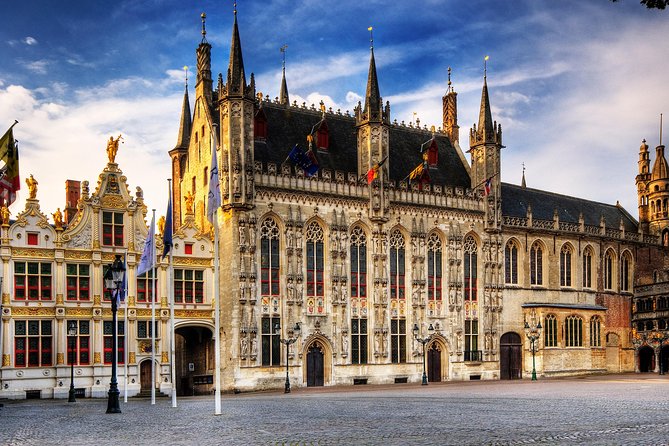
The final stop is Burg Square, reached after passing the old Fishmarket. This square is described as the political heart and birthplace of Bruges, so it makes sense as the endpoint.
Ending here gives the tour a strong shape. You begin with trade and power at Markt, then move through religion, art, daily work, local legends, and royal conflict before arriving at the place where the city’s political identity took root.
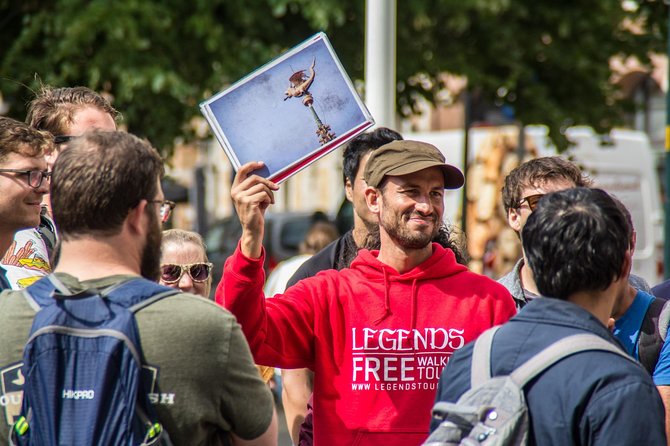
The 15-minute stop lets the guide tie the stories together. It also leaves you in a central location for continued sightseeing. Use the last few minutes to ask about places to eat, buy chocolate, or revisit. Guides such as Celine and Martin have been praised for offering practical local suggestions, while guides including Victoria, Wouter, and Sander have been singled out for humor, visual aids, and strong storytelling.
Guide style matters more than the low price
The guide is the main variable here. The strongest experiences come from a person who can turn dates and buildings into a clear story. Louis has been praised for his love of the city and detailed answers. Victoria is known for charisma and humor. Martin, Sander, Wouter, Thomas, Emiel, Erik, Sam, Patrick, Celine, and Willem have also been praised for friendly delivery, local insight, or strong command of Bruges’ past.
That range is encouraging, but it also means the tone may vary by departure. Some guides may lean more toward political history, while others add personal stories and cultural detail. One fair criticism is that the tour can focus more on history and people than on broader social and cultural life.
The group limit is 24 people. That is small enough to feel manageable, though a full departure may make questions harder. A group of four, as happened on one occasion, allows much more conversation than a full group.
Who should book, and who should think twice?
I recommend this tour for first-time visitors, day trippers, families who want a clear route, and anyone who has only one day in Bruges. It is especially useful if you want to see the major sights before choosing where to spend your own time.
It also suits budget-minded visitors. At $3.62, the financial risk is tiny, provided you understand that tips are recommended. The value comes from the route, the guide, and the stories that help you read the city.
You should think twice if you dislike walking for more than two hours, need long indoor breaks, or want detailed access to every museum and church. The tour requires good weather, and a freezing day was enough for one family with a toddler to leave early. Wear sensible shoes and check the forecast.
Confirmation arrives at booking, service animals are allowed, and the activity is near public transportation. Most people can take part, but the route still demands steady walking. Free cancellation is available up to 24 hours before the start time. A late cancellation is not refunded, and a weather or minimum-participant cancellation brings a choice of another date or a full refund.
Should you book Legends of Bruges?
Yes, if you want a low-cost, story-led introduction to Bruges. The route covers more ground than a casual stroll, and the best guides turn the city’s famous views into a connected story about trade, power, religion, work, and local legends.
Book it near the start of your stay so you can return to the Belfort, church, museum, brewery, or beguinage with better context. Just keep your expectations clear: this is an outdoor overview, not a series of full museum visits. If you can handle the walk and plan to tip the guide, it is an unusually affordable way to get your bearings in Bruges.
FAQ
How long does the Historical Walking Tour: Legends of Bruges last?
The tour lasts approximately 2 hours and 15 minutes.
Where does the tour start?
It starts at Pieter de Coninck en Jan Breydel Markt in Bruges.
Where does the tour end?
The tour ends at Burg Square, at Burg 15 in Bruges.
Is the tour offered in English?
Yes. The experience is offered in English.
How many people can join the tour?
The maximum group size is 24 people.
Can I cancel for a full refund?
Yes. You can cancel at least 24 hours before the start time for a full refund. Cancellations or changes made within 24 hours are not refunded, and poor weather or insufficient participation may lead to another date or a full refund.
More Walking Tours in Bruges
- Bruges: Small Group Boat Cruise and Guided Walking Tour
★ 4.8 · 4,102 reviews - Bruges: Walking Tour, Canal Boat Trip w/Beer Tasting Option
★ 4.4 · 2,759 reviews - Guided boat trip and walk
★ 4.5 · 703 reviews - Bruges: Guided Walking Tour
★ 4.5 · 682 reviews
Just added around Bruges
- 2-Hour Private Walking Tour of Bruges★ 5.0 · 13 reviews
- The Waffles ‘n Coffee Breakfast in Bruges Centre★ 4.5 · 9 reviews
- Ticket Expo Body Worlds in Bruges, Belgium★ 4.5 · 11 reviews
- Discover the secrets of Bruges by playing!★ 4.5 · 7 reviews
- Explore the Instaworthy Spots of Bruges with a Local★ 5.0 · 3 reviews
- Australian Battlefields Private Tour in Flanders from Bruges★ 5.0 · 15 reviews
- 6 Hour Bruges Shore Excursion from Zeebrugge Cruise Port★ 4.5 · 23 reviews
- Photo Tour “Jan van Eyck”★ 4.0 · 7 reviews
Dark Side & Legends Tours, compared.
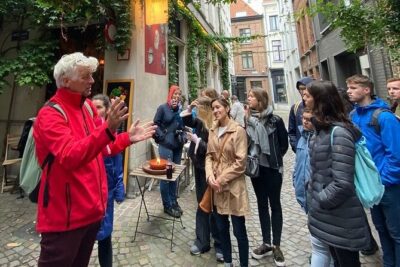
Historical Walking Tour: The Story of Bruges – by Legends
Read our review →
Historical Walking Tour: The Story of Brussels – by Legends
Read our review →Browse the lists this tour appears in