

Reviewed · DARK SIDE & LEGENDS TOURS
Evening Tour of the Dark Side of Gent
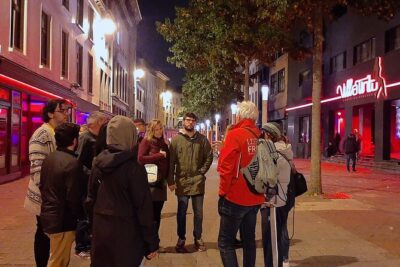
Ghent’s prettiest streets look different after sunset, especially when your guide explains the murders, punishments, religious conflicts, and political power struggles behind the grand buildings. This 1-hour-45-minute walking tour uses the city itself as a stage, mixing documented history with legends and a healthy dose of dark humor.
I like the excellent value, with a price of about $3.62 per person, and I like the route’s balance between famous sights and quieter corners. Guides including Kenny, Isabel, Ben, and Julian are praised for lively storytelling, jokes, and useful local details. The main caution is that the tour depends on a minimum number of participants and good weather, and a few people have found the dark material lighter than the title suggests.
At a glance: what makes this walk worthwhile
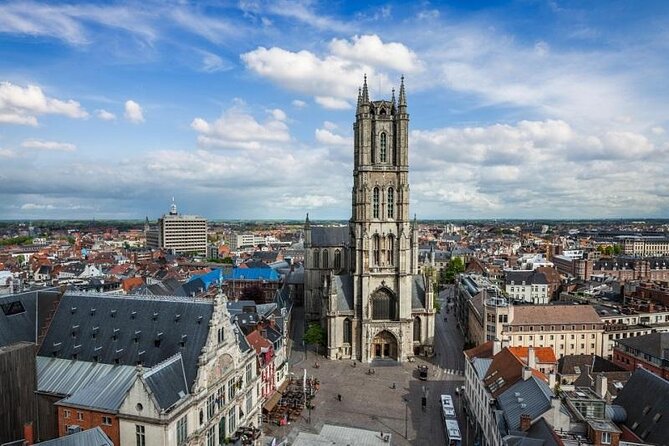
- Medieval Ghent after dark: See the city’s bridges, towers, canals, fortifications, and old quarters in a more atmospheric setting.
- Stories beyond the postcard view: Hear about torture, executions, religious wars, industrial change, and political trouble.
- Strong guide-led storytelling: Kenny receives especially warm praise for humor, energy, and involving the group.
- A slow, mostly level route: The walk suits most people, but comfortable shoes still matter.
- A useful city orientation: The route ends in Patershol, close to bars and restaurants in the center.
- Not every tale is fully historical: Legends and dramatic stories are part of the fun, so keep a little skepticism handy.
Why Ghent’s dark side makes a good evening walk
Ghent is often presented through its handsome canals, medieval towers, and grand civic buildings. Those sights are worth seeing, but they can feel a little too polished if you only admire the façades. This walk gives you the less flattering story: how power was enforced, how criminals were punished, how religious disputes shook the city, and how ordinary people lived through major political and economic changes.
You begin near Hostel Uppelink at St Michael’s Bridge. This is a smart starting point because the view gathers several major landmarks into one frame. Your guide first explains Ghent’s role as a medieval trading center and points out the city’s three famous towers. At night, the skyline has a theatrical quality, and the opening story helps you understand why Ghent became so important in the first place.
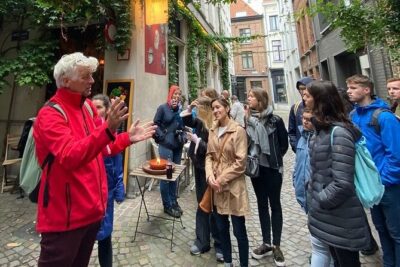
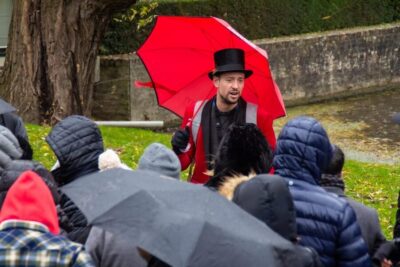
The walk is not a formal lecture. Guides use jokes, dramatic details, and legends to keep the group moving. Kenny is especially associated with an animated style and a morbid sense of humor, while Isabel, Ben, and Julian have also led engaging versions of the route. The exact tone can vary with the guide, which is one reason the experience may feel more like a lively story walk than a fixed historical presentation.
More dark side and legends walks in Ghent:
- Historical Walking Tour: Legends of Gent
★ 5.0 · 1,761 reviews - Private Tour: The Dark Side of Gent
★ 5.0 · 73 reviews - Ghent: The Dark Side of Ghent Private Walking Tour
★ 4.9 · 19 reviews
St Michael’s Bridge and the three towers
The first stop gives you a quick orientation to Ghent’s medieval power. From St Michael’s Bridge, you can see the three towers that define the central skyline: St Nicholas’ Church, the Belfry, and St Bavo’s Cathedral.
Your guide explains how trade helped Ghent grow into an important European city. That context matters because much of the tour’s darker material comes back to one basic question: who controlled the city’s money, laws, religion, and defenses?
The cathedral receives its own grim story. You will hear why this beautiful building is also linked with the name Devil’s Tower. The point is not simply to shock you. It shows how local legends attach themselves to major buildings and how a city’s most impressive monuments can carry unsettling stories beneath their polished surfaces.
This is also one of the better places for nighttime photographs. The view is broad, the architecture is easy to frame, and the opening stop helps you recognize the landmarks you will encounter later.
Graslei, Korenlei, and the old harbour economy
From the bridge, the route continues to Graslei and Korenlei, the historic harbour area. These quays are among Ghent’s most attractive places, with medieval façades lining the water and reflections adding extra drama after dark.
The guide shifts from skyline views to trade. You hear how goods moved through the harbour and how commercial success made Ghent a major economic force. The stories here are less about blood and punishment and more about the money that shaped the city.
I like this part because it keeps the tour from becoming a string of horror tales. Ghent’s dark past makes more sense when you first understand its wealth. Prosperity brought influence, but it also created competition, social divisions, and a powerful ruling class determined to protect its position.
The stop is short, around ten minutes, so you get enough explanation without standing in one place too long. If you want detailed information about every building along the quays, this will feel brief. For a general introduction to the city’s commercial past, the timing works well.
Appelbrugparkje and the execution legend
At Appelbrugparkje, the guide looks across toward the large Butchers’ Hall and tells the story of a father and son facing execution. A miraculous event supposedly saves them, giving the stop a strong blend of violence, religion, and legend.
This is one of the clearest examples of the tour’s approach. You are not getting only verified political history. You are also hearing the tales people have attached to bridges, buildings, and public spaces over the centuries.
That mixture will suit you if you enjoy folklore and old stories told with a wink. If you want every claim carefully separated into fact and fiction, you may need to listen critically. One version of the tour may lean more heavily into the legend than another, since each guide has some freedom in how the material is presented.
The nearby Butchers’ Hall adds visual impact. Even without entering it, the building gives the story a fitting setting. The route uses these small connections well, placing each tale where it feels most at home.
More evening outings in Ghent:
- Evening Tour: The Dark Side of Bruges
★ 5.0 · 956 reviews - Evening Tour: The Dark Side of Brussels
★ 4.5 · 435 reviews - Evening Walking Tour: The Dark Side of Antwerp
★ 5.0 · 193 reviews - Bruges at Night: Murder, Mystery & Dark Stories Small Group Walk
★ 5.0 · 137 reviews
The Castle of the Counts and medieval power
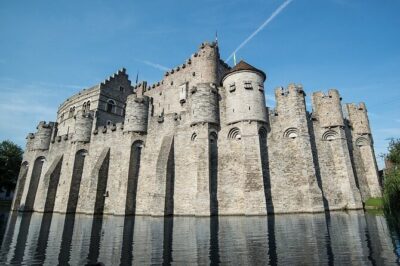
The Castle of the Counts is the route’s most imposing stop. Count Baldwin built the original fortification in the ninth century to protect local people from Viking raids, and the stronghold later became central to Ghent’s development.
A castle tour can easily become a list of dates and rulers. Here, the focus is on power, defense, punishment, and the people who controlled the city. The fortress gives the dark theme a physical center. Thick walls and towers make it easy to imagine a place built not for comfort, but for control.
You will hear about the castle’s history without taking a full interior tour. That distinction matters. If you want rooms, exhibits, and a detailed architectural visit, plan a separate daytime stop. This evening walk gives you the setting and the stories from outside, with the castle’s silhouette doing much of the work.
The route then moves toward what was once the Prince’s Court, a huge palace that is now difficult to picture in its original form. Your guide has to rely on description and imagination here, but that can be rewarding. The absence of a complete palace leaves space for a story about lost grandeur, changing power, and the way cities erase and rebuild themselves.
Rabot Sluice and the last surviving defense tower
Rabot Sluice provides a change of scenery and a useful lesson in Ghent’s defenses. The guide points out the only remaining tower from the medieval defense wall, which once stretched for about 14 kilometers around the city.
This stop shows how much of Ghent’s old protective system has disappeared. A single surviving tower can seem modest beside a castle, but it represents a far larger structure and the scale of medieval anxiety. Walls were expensive, labor-intensive, and politically important. They separated the city from threats outside and helped authorities control movement within.
The location also takes you beyond the most familiar central streets. Several parts of the route are less obvious than the usual canal views, and this is where the walk begins to feel like a practical introduction to corners you might not find on your own.
The walk remains mostly level and moves at an unhurried pace. Still, you are on foot for nearly two hours, often on old city surfaces. Wear comfortable shoes rather than treating this as a stroll for dress shoes.
Keizer Karel and the scars of religious conflict
The stop connected with Keizer Karel centers on the Bridge of Imperial Delights. Four sculptures show legendary scenes from the life of Charles V, and the guide explains what some of them mean.
This is a small but useful stop because it teaches you to look closely. Sculptures can be easy to pass without a second thought, especially at night. With a guide pointing out the figures and stories, the bridge becomes more than a crossing.
The discussion then turns to the Religious Wars and the impact of Calvinist rule on Ghent. This section adds political and religious conflict to the tour’s earlier stories of trade and punishment. You get a sense of how quickly a city’s public life could change when control shifted between competing religious and political forces.
The subject is serious, but the delivery remains accessible. Guides tend to mix explanation with humor, which helps keep the material from becoming heavy. You should expect talk of violence, repression, and social upheaval, but not an academic seminar.
Patershol and Ghent’s industrial revival
The tour ends in Patershol, the medieval quarter known as Monk’s Hole. Its narrow streets and old buildings make a fitting final setting, but the subject changes from medieval cruelty to the social effects of the Industrial Revolution.
You hear how industrial change affected Ghent and how the city’s economy later revived. This gives the tour a broader ending than simple doom and gloom. Ghent’s past includes suffering and injustice, but it also includes adaptation and renewal.
Patershol is a practical place to finish. You are still in the city center, surrounded by cozy bars and restaurants, so you can continue the evening without arranging transport. If you are deciding where to eat afterward, this location gives you an easy starting point.
The final stop also helps explain why the city feels layered. Medieval streets, industrial change, religious conflict, and modern dining all sit close together. That physical closeness is one of the best things about exploring Ghent on foot.
What the price and format mean for you
At about $3.62 per person, this is unusually inexpensive for nearly two hours with a guide. Even if you treat the price as a modest contribution for a walking tour, the value is strong. You receive a city orientation, nighttime views, local legends, and access to a route that would be difficult to create from a guidebook alone.
The low price does not mean you should expect a private experience. The group can include up to 35 people, so the guide’s voice and your position in the group matter. Stand near the guide when possible, especially at the start and at stops near traffic or open public spaces.
The walk is offered in English and uses a mobile ticket. Confirmation is provided at booking. The meeting point is Hostel Uppelink at Sint-Michielsplein 21, and the route ends in Patershol.
There is one practical warning: arrive early and confirm the exact meeting point. A few people have missed the walk after confusion over timing or directions, while the operator maintains that the guide was waiting at the stated location. Since the group may leave before the advertised start time, giving yourself extra time is sensible.
The tour requires good weather and a minimum number of participants. If poor weather or low attendance causes cancellation, you are offered another date or experience, or a full refund. You can cancel for a full refund up to 24 hours before the start time, but later cancellations and changes are not refunded.
Who will enjoy the Dark Side of Gent?
I would choose this walk if you like city history delivered through stories rather than long explanations. It suits adults, couples, solo visitors, and families with older children who can handle talk of murder, torture, executions, and religious conflict.
It is also a good first-night activity in Ghent. The route gives you a map in your head, shows you where the main sights connect, and ends near food and drinks. You can then return to the places that caught your interest during daylight.
You may want something else if you dislike gruesome subjects or prefer a strictly factual historical tour. The dark material varies by guide, and one version may feel more like a general city history walk with a few grim stories. The title promises more blood and mystery than every guide will deliver.
Should you book it?
Book the Dark Side of Gent if you want a cheap, social evening walk with humor, local legends, and a look at Ghent beyond its pretty canals. Kenny is a particularly strong choice if his name appears when you book, but Isabel, Ben, and Julian have also brought energy and personality to the route.
Skip it if you need a small private group, a rigorous academic account, or a guaranteed focus on gruesome tales. For most visitors, though, the combination of striking night views, unusual stops, relaxed walking, and a Patershol finish makes this one of the better-value ways to get oriented in Ghent.
FAQ
How long does the Evening Tour of the Dark Side of Gent last?
The walk lasts approximately 1 hour and 45 minutes.
Where does the tour begin?
It begins at Hostel Uppelink, Sint-Michielsplein 21, 9000 Gent, Belgium.
Where does the tour end?
The tour ends in Patershol in central Ghent, an area with bars and restaurants.
What language is the tour offered in?
The experience is offered in English.
Is the tour suitable for most people?
Most people can participate, and the walk is described as slow-paced and mostly level. Comfortable shoes are a good idea because the experience involves substantial walking.
Can I cancel for a refund?
You can cancel up to 24 hours before the start time for a full refund. Cancellations or changes made less than 24 hours before the start time are not refunded. Poor weather or failure to reach the minimum number of participants may lead to a different date, another experience, or a full refund.
Just added around Ghent
- Historic Highlights, by a local guide★ 5.0 · 9 reviews
- Discover Ghent while playing! Escape game – The alchemist★ 4.0 · 4 reviews
- Walking Food Tour in Ghent★ 5.0 · 13 reviews
- Discover Ghent while playing! Escape game – The Walter case★ 4.5 · 4 reviews
- Discover Ghent with a self-guided Outside Escape city game tour!★ 4.0 · 10 reviews
- Ghent Walking Tour with Audioguide on Your Smartphone★ 4.5 · 13 reviews
- e-Scavenger hunt Kortrijk: Explore the city at your own pace★ 4.5 · 15 reviews
- Private Ghent Beer & Brewery Tour by a young local★ 5.0 · 12 reviews
Dark Side & Legends Tours, compared.

Historical Walking Tour: The Story of Bruges – by Legends
Read our review →
Historical Walking Tour: The Story of Brussels – by Legends
Read our review →Browse the lists this tour appears in