
Reviewed · WALKING TOURS
Bruges Private 2-Hour Walking Tour
Bruges is easy to admire and surprisingly easy to misunderstand. This private walk gives you the story behind the handsome squares, canals, churches, and old trading streets, with guides such as Jan, Dirk, Paul, and Erik bringing their own local knowledge to the route. Jan Van Eyck Square is a real highlight because it shows Bruges as a major medieval business center, not just a pretty canal town.
I like the private format, which lets your guide adjust the pace and answer your questions instead of delivering a fixed speech to a large group. I also like the ending at Minnewater and the Princely Béguinage, since it brings you away from the busiest central streets and into one of Bruges’s most peaceful corners.
The main drawback is time. Two hours is enough for orientation and major sights, but not for long interior visits. Entrance fees and meals are extra, and the walk can feel brisk if you want to stop often for photos or museum visits.
Key points to know before you book
- Private group for up to 20 people: The $223 price covers the group, not each person, so it can be good value for a family or larger party.
- A strong first look at Bruges: The route links the Cathedral, Market Square, Burg, Jan Van Eyck Square, canals, St. John’s Hospital, Minnewater, and the Béguinage.
- Local guides add personality: Guides who have led this walk include Jan, Theo, Paul, Dirk, Erik, Daniel, and Pieters.
- Central pickup is included: Meet at your old-center hotel, Bruges train station, or the Tourist Office In & Out at ’t Zand.
- Five languages are available: You can request English, Dutch, French, German, or Spanish.
- Good flexibility for private groups: Past tours have adapted to family pace, questions, rain, and mobility needs.
Why two hours works well in Bruges
Bruges has a compact old center, but its sights are spread across a maze of squares and narrow streets. A short private walk helps you connect the pieces. You begin with the main commercial center, move through the old financial quarter, then pass the civic and religious landmarks before reaching the quieter southern end of town.
I see this as a first-day tour, not a complete Bruges experience. You get a clear map in your head and a useful set of recommendations for later. After the walk, you can return to the Market Square, visit a museum, enter a church, or simply follow a canal without wondering how the city fits together.
The private setup matters here. A guide can explain why one square mattered more than another, pause when you want a photograph, or spend extra time on a subject that catches your attention. Several past guides, including Dirk and Paul, were praised for changing the pace and responding to questions rather than sticking rigidly to a script.
The walk is priced at $223 per group of up to 20 people. For one or two people, that is a substantial cost compared with a shared group tour. For a family, reunion, or group of friends, the price becomes easier to justify because everyone receives one guide and the cost does not rise per person up to the stated limit.
More Walking Tours in Bruges
- Bruges: Small Group Boat Cruise and Guided Walking Tour
★ 4.8 · 4,102 reviews - Bruges: Walking Tour, Canal Boat Trip w/Beer Tasting Option
★ 4.4 · 2,759 reviews - Historical Walking Tour: Legends of Bruges
★ 5.0 · 2,541 reviews
Starting at ’t Zand and St. Savior Cathedral
The sample route begins at ’t Zand Square, beside the Concert Hall. If your hotel is in the historic center, pickup at the lobby is available. You can also meet at Bruges train station or the Tourist Office In & Out at ’t Zand 34.
From there, you walk along the main shopping street toward the Market Square. This is a practical opening because you begin in a part of Bruges that most people can find easily. Your guide can point out how the modern shopping route connects with the older core rather than treating the city as a set of unrelated photo stops.
St. Savior Cathedral is the first major sight. It is one of the city’s important churches and gives the tour an early architectural anchor. The visit here is mainly an exterior and orientation stop within the two-hour route, since entrance fees are not included and the schedule must cover much more ground.
If you want lengthy church visits, tell your guide early. The private format may allow some adjustment, but the route has a lot packed into two hours. I would save detailed interior viewing for after the walk unless a particular church is your top priority.
Market Square and the 83-meter Belfry
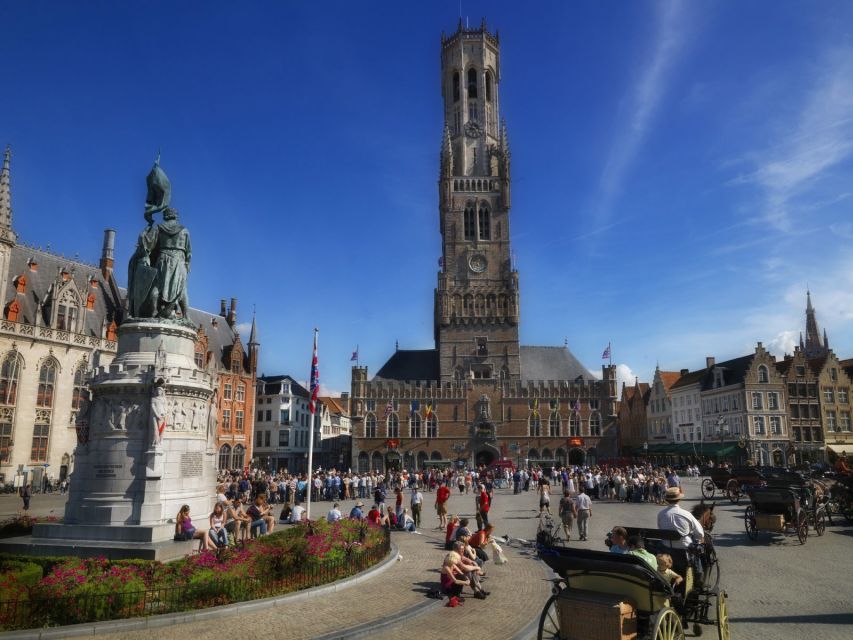
The Market Place, or Markt, is Bruges’s grand central square. Its defining feature is the 83-meter Belfry, a tall medieval tower that has watched over the city for centuries. You will have time to take in the square and hear why the tower matters, but this tour does not include an entrance ticket for climbing it.
The square is one of Bruges’s most obvious sights, yet a guide gives it more meaning. Without context, you see grand buildings and a tall tower. With context, you begin to understand the square as the city’s public and commercial center, where civic life and trade met.
This is also where the two-hour limit becomes clear. If you want to climb the Belfry, linger over every building, and take many photographs, you will need extra time after the tour. The walk is designed to show you the main structure of Bruges, not to provide a full visit inside each attraction.
Jan Van Eyck Square and the old trade quarter
Jan Van Eyck Square is one of the strongest parts of the route. From the 13th to the 15th century, it was the financial and economic center of Flanders. That makes it a useful counterpoint to the Market Square: here, you see the commercial machinery behind Bruges’s success.
The square’s buildings recall the city’s role as a major trading center. Your guide also points out the City Theater, the Saaihalle from 1399, Huis ter Beurze, and the Toll House. These are not random old façades. Together, they show how business, shipping, taxes, and civic life worked in medieval Bruges.
Huis ter Beurze has special interest because it is linked to the early development of the stock exchange. The name itself is associated with the idea of a bourse. You do not need a long lecture to appreciate the point: Bruges helped shape the commercial world that later spread across Europe.
This stretch is where a local guide can make the biggest difference. A quick walk might leave you admiring the buildings. A good explanation helps you read them as evidence of money, trade, and political power.
Same city, a completely different kind of day out:
- Bruges: Choco-Story Chocolate Museum Guided Tour w/Tastings
★ 4.2 · 1,379 reviews - From Bruges: Great War Flanders Fields Minibus Tour w/ Lunch
★ 4.9 · 1,257 reviews - Bruges: Guided Rickshaw Tour
★ 4.9 · 1,199 reviews - Round-Trip Shuttle Service from Zeebrugge to Bruges
★ 4.0 · 1,143 reviews
Burg Square and the Basilica of the Holy Blood
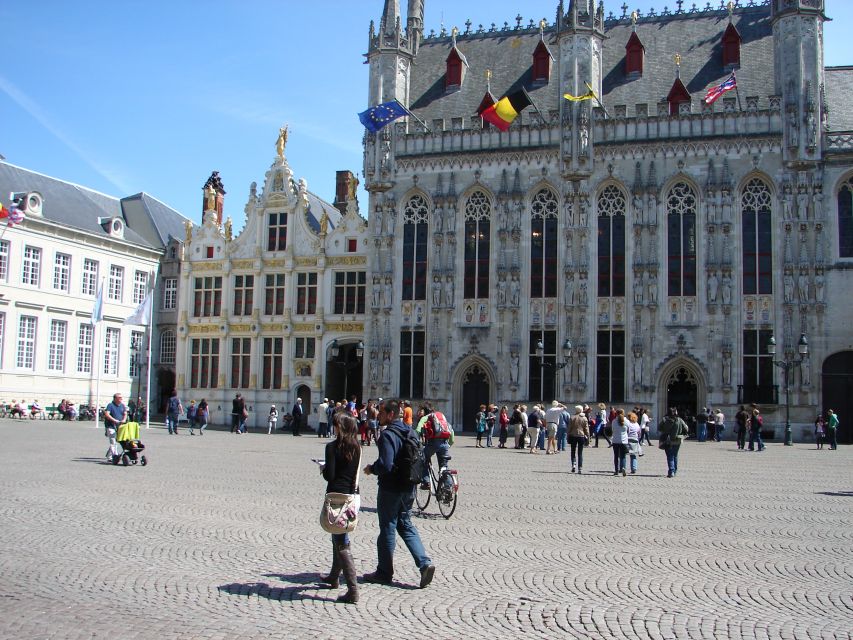
The route continues to Burg Square, one of the most attractive civic spaces in Bruges. Here you see the Gothic City Hall, the Basilica of the Holy Blood, and the Liberty of Bruges, a former courthouse that now houses the Municipal Archives.
Burg Square gives you several layers of Bruges in one compact setting. The City Hall represents civic authority. The basilica represents religious importance. The former courthouse shows how government operated. I like this part because the guide can explain how the city’s institutions sat side by side, rather than presenting each building as an isolated monument.
The Basilica of the Holy Blood is especially important to many people because it holds a relic associated with the Holy Blood. Past tours have included a look at the relic and the Romanesque chapel on the lower level, though you should remember that entrance fees are not included and access can depend on the timing and conditions of your visit.
If you want to see inside, mention it when you meet your guide. The walk is private, so there may be more room to adapt than on a fixed group outing, but two hours still places limits on how long you can stay.
Fish Market, Tanners Square, and the Dijver
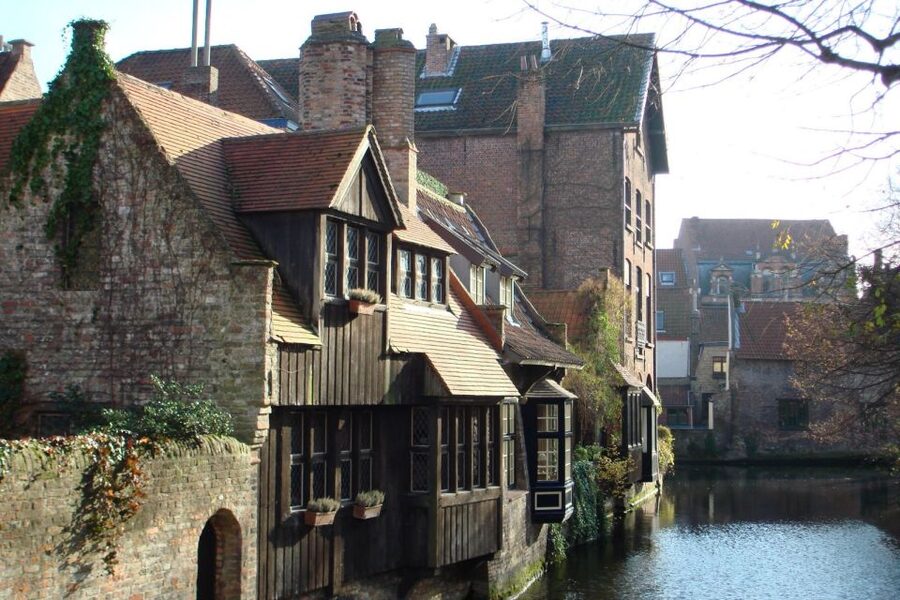
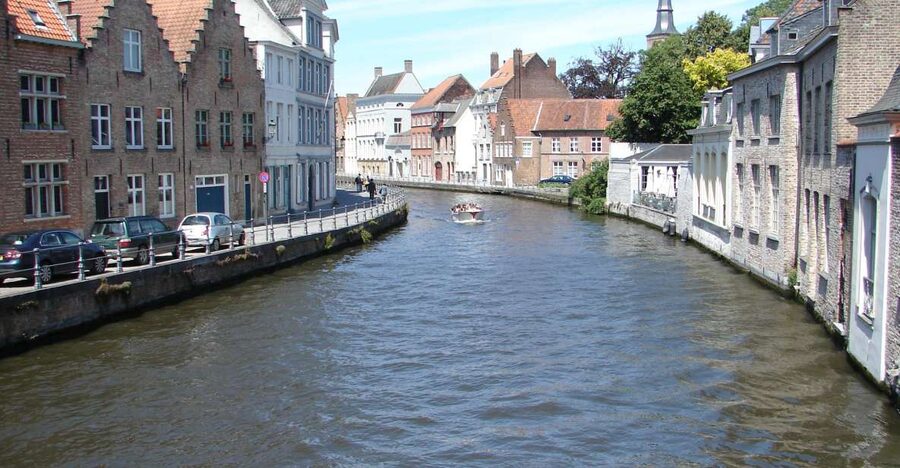
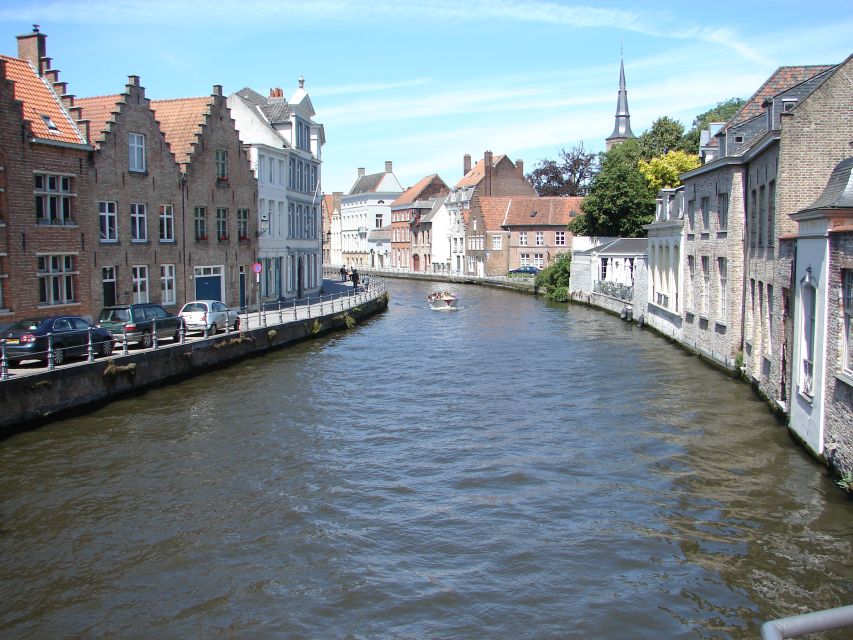
After Burg Square, the route moves through the Fish Market and Tanners Square before reaching the Dijver. This is one of the more atmospheric sections of the walk, with water, old façades, and narrow streets replacing the broad civic spaces.
The Fish Market and Tanners Square point to everyday commerce and working life. They are useful reminders that Bruges was not built only for grand ceremonies. The city depended on trade, craft, food, transport, and the people who worked along its waterways.
Dijver is among the most picturesque parts of the route. It is also a good place to slow down for photographs if the group is moving at a comfortable pace. Past tours have included time for canal views and swans, a small detail that captures Bruges at its most peaceful.
I would not expect a long stop at every corner. The value here is the sequence: you move from power and religion to trade, water, and daily work. That changing mood is one reason a guided route is useful.
St. Mary’s Church and St. John’s Hospital
The walk then passes St. Mary’s Church and reaches St. John’s Hospital. St. Mary’s is one of the city’s major churches, while St. John’s Hospital is one of Europe’s oldest preserved hospital buildings.
The hospital is a particularly worthwhile stop because it adds a human side to the city’s past. Bruges was not only a place of merchants and officials. It also cared for the sick, and the surviving hospital building gives you a direct sense of that older social world.
Past private tours have also included a brief look at the Groeningemuseum, especially for people interested in art. Do not assume that a full museum visit is part of the standard two-hour route. The museum is best treated as a possible recommendation or short orientation stop, followed by your own visit after the walk.
St. Mary’s Church can also require extra time if you want to see its interior and Michelangelo’s Madonna and Child. The tour can help you find the church and understand its importance, but the route is not built around long museum or church visits.
Minnewater and the Princely Béguinage
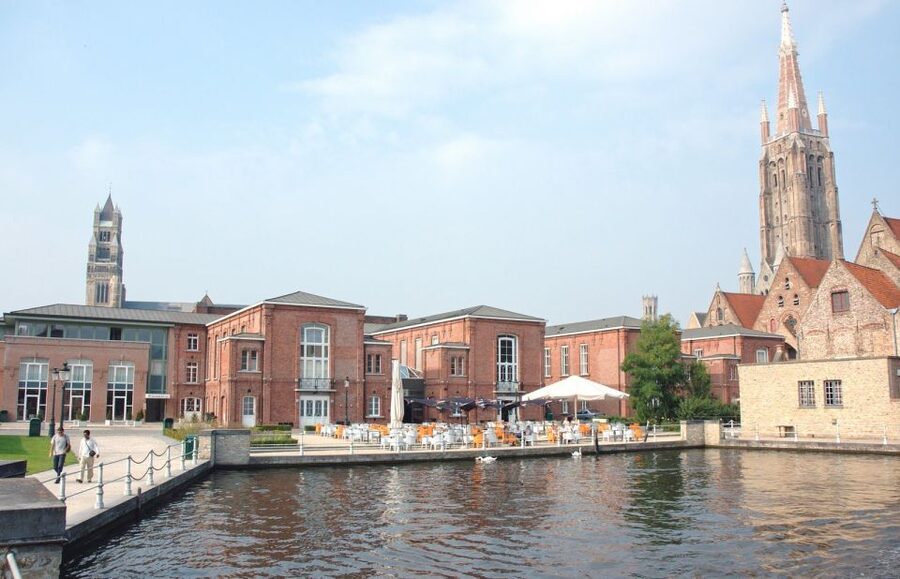
The walk ends at Minnewater and the Princely Béguinage. This is a smart ending. After the crowded central sights and commercial streets, you reach a quieter part of Bruges with a gentler pace.
The Princely Béguinage dates to the 13th century. Béguinages were communities for religious women who lived together without taking the same vows as nuns. The white buildings and enclosed setting give this stop a different feel from the Market Square or Burg.
Minnewater adds another scenic pause, with water, bridges, and the chance to take photographs. The route’s final section is less about grand architecture and more about mood. I like that the tour does not finish at the loudest or most obvious point in town.
Because the walk ends here, you can continue exploring on your own or make your way back toward the center. Ask your guide for suggestions before parting. Past guides have offered advice on food, chocolate, waffles, fries, and places worth seeing next.
The guides and the value of a private walk
The strongest feature of this experience is the guide. Names associated with past tours include Jan, Theo, Paul, Dirk, Erik, Daniel, and Pieters. Their styles may differ, but the useful pattern is clear: you are booking a person who can respond to your group, not just a route that runs on its own.
Jan has led tours that kept teenagers involved with history and facts. Paul has connected monuments with his own life in Bruges, including stories from growing up in the city. Dirk has been flexible with pace and mobility needs, while Erik has combined hotel pickup with a broad introduction to the main sights.
That does not guarantee a particular guide or style, so you should book this with realistic expectations. The experience depends heavily on who leads it and on what your group asks. The good news is that the private format gives you room to speak up. Ask about trade, churches, art, food, or local life, and use the guide as a starting point for the rest of your visit.
The route also has some practical flexibility. One tour began late but still continued for the full two hours and longer. Another changed its meeting place at short notice. Those details do not remove the need to confirm your meeting point, but they suggest that the operator can handle ordinary changes.
Pace, weather, and mobility
This is a walking tour through the historic center, so comfortable shoes matter. You will cover a series of squares, streets, canals, churches, and historic buildings in only two hours. If you stop constantly, you may need to choose between taking photographs and covering the full route.
Rain does not make the city impossible. One guide kept much of a tour under cover during heavy rain while still showing the main sights. Still, bring suitable clothing because the walk includes outdoor stretches and the weather can affect how much time you want to spend in open squares.
The private structure is useful for groups with different abilities. A guide has adapted the pace for a wheelchair and accommodated a mother with mobility issues. The supplied details do not promise a fully step-free route, so discuss your needs when arranging the tour. That is especially important if you hope to enter churches, museums, or historic buildings.
The tour is also suitable for families. A guide who can change the explanation for teenagers is far more useful than a fixed speech full of dates. You can ask for a lighter pace, more stories, or sharper focus on the sights your children care about.
Who should book this Bruges tour?
I would book it for a first visit, a family group, or a party of friends who want one guide for themselves. It is also a good fit if you arrive by train and want to start from the station, or if your hotel is in the historic center and you prefer pickup at the lobby.
It suits people who want context but do not want to spend half a day on a formal tour. The route covers the essential center while also reaching Jan Van Eyck Square, the canals, Minnewater, and the Béguinage.
I would choose a different plan if your main goal is extended time inside museums, climbing the Belfry, or carefully touring every church. Entrance fees are not included, and two hours leaves little room for long interior visits.
The tour offers free cancellation up to 24 hours before the start, and you can reserve now and pay later. Those terms help if your schedule is still shifting, though you should still check the available starting times before booking.
Final call: book it for orientation and personal attention
Book this Bruges private walking tour if you want the city explained in a clear two-hour route, with the freedom to ask questions and adjust the pace. The best parts are the link between the famous sights and the old trading quarter, plus the quieter finish at Minnewater and the Princely Béguinage.
The $223 group price is easiest to justify with several people. For a couple, it is a premium choice, but the private attention may be worth it if you care about history, have limited time, or need a flexible pace.
My advice is to treat the tour as your Bruges foundation. Let the guide show you the city’s structure, ask for food and museum tips, then use the rest of your day to return to the places that caught your eye.
FAQ
How long is the Bruges private walking tour?
The tour lasts two hours.
How much does the tour cost?
The price is $223 per group of up to 20 people.
Is the tour private?
Yes. It is offered for a private group, with one private guide for the two-hour walk.
Which languages are available?
The tour is available in Spanish, Dutch, English, French, and German.
Where can the tour begin?
Pickup is available at the lobby of a hotel in Bruges’s historic center, Bruges train station, or the Tourist Office In & Out at ’t Zand 34, 8000 Brugge.
Which main sights are included?
The route includes St. Savior Cathedral, Market Square and its Belfry, Jan Van Eyck Square, Burg Square, the Gothic City Hall, the Basilica of the Holy Blood, the Liberty of Bruges, the Fish Market, Tanners Square, Dijver, St. Mary’s Church, St. John’s Hospital, Minnewater, and the Princely Béguinage.
Are entrance fees included?
No. Entrance fees are not included in the tour price.
Are meals included?
No. Meals are not included.
Can I cancel for a full refund?
Yes. You can cancel up to 24 hours in advance for a full refund.
More 2-Hour Experiences in Bruges
- 2-Hour Historical Walking Tour in Bruges with Praline Included
★ 5.0 · 291 reviews - 2-Hour Medieval Walk and Chocolate Tasting in Bruges
★ 5.0 · 48 reviews - 2-Hour Private Walking Tour of Bruges
★ 5.0 · 13 reviews - Guided Bike Tour: 2 Hours Highlights of Antwerp
★ 5.0 · 347 reviews
Just added around Bruges
- 2-Hour Private Walking Tour of Bruges★ 5.0 · 13 reviews
- The Waffles ‘n Coffee Breakfast in Bruges Centre★ 4.5 · 9 reviews
- Ticket Expo Body Worlds in Bruges, Belgium★ 4.5 · 11 reviews
- Discover the secrets of Bruges by playing!★ 4.5 · 7 reviews
- Explore the Instaworthy Spots of Bruges with a Local★ 5.0 · 3 reviews
- Australian Battlefields Private Tour in Flanders from Bruges★ 5.0 · 15 reviews
- 6 Hour Bruges Shore Excursion from Zeebrugge Cruise Port★ 4.5 · 23 reviews
- Photo Tour “Jan van Eyck”★ 4.0 · 7 reviews
Walking Tours, compared.

Small Group Boat Cruise and Guided Walking Tour
Read our review →
Walking Tour, Canal Boat Trip w/Beer Tasting Option
Read our review →

Historical Walking Tour with Chocolate & Waffle Tasting
Read our review →
Brussels Walking and Tasting Tour (Beers,Chocolates&Fries/Waffle)
Read our review →
Browse the lists this tour appears in