
Reviewed · HISTORICAL TOURS
Historic Highlights, by a local guide
Ghent reveals itself best through the stories behind its buildings, and this walk gives you those stories with local historian Jürgen. He traces the city from the old waterways to the Castle of the Counts, adding personal insight and the occasional bit of local gossip.
I like the small-group feel, with a maximum of 20 people and the possibility of a much smaller outing. I also like the route’s range: you get major sights such as St. Bavo’s Cathedral and Gravensteen, along with quieter streets and local advice on food, markets, and drinks.
The main drawback is that this is an outdoor walking tour, and several important interiors require separate admission. Rain can also affect the experience, so bring suitable clothing and plan extra time if you want to enter the cathedral, palace, or castle.
Key points at a glance
- A historian leads the walk: Jürgen is a local history professor who was born and raised in Ghent.
- The route follows Ghent’s origins: Begin near the old Spanish Castle moat and the meeting point of the Leie and Schelde rivers.
- Major sights are viewed from outside: St. Bavo’s Cathedral, Hotel d’Hane Steenhuyse, and Gravensteen require separate admission if you want to go inside.
- Patershol adds a local side of town: This old quarter has small restaurants and an offer at Enzo from Pizzeria Neapolis.
- The tour ends at Vrijdagmarkt: You finish with an explanation of Ghent’s socialist movement, near bars and restaurants.
- The price is $40.33 per person: That is fair for a two-hour private-style history walk, especially for first-time visitors who want context fast.
Why Jürgen’s Ghent walk works so well
The best feature here is not simply the number of sights. It is the way Jürgen connects them. Ghent can feel like a collection of handsome churches, canals, guild buildings, and narrow lanes until someone explains how the pieces fit together.
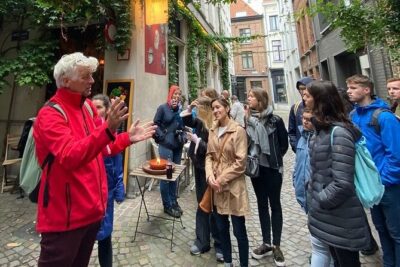
Jürgen teaches history and has a clear affection for his hometown. That combination matters. You get dates and political context, but also the stories behind buildings and the reasons certain streets developed as they did. He is also described as attentive to the group, adjusting his explanations and pace to suit different interests.
I would choose this walk early in a Ghent visit. Two hours is enough to get your bearings without using up half a day, and the route finishes near places where you can continue eating or exploring. You can then return to the cathedral, castle, or palace with a better sense of what you are seeing.
The tour begins at 3 p.m. and ends at Oudburg 17, near Vrijdagmarkt. The start is on Hagelandkaai, so allow enough time to reach the correct side of the city before the meeting time. You receive a mobile ticket, and the tour operates near public transportation.
More Historical Tours in Ghent
- Ghent: 50-Minute Medieval Center Guided Boat Trip
★ 4.5 · 5,637 reviews - Historical Walking Tour: Legends of Gent
★ 5.0 · 1,761 reviews - Ghent: 40 Minute Medieval Center Guided Boat Tour
★ 4.4 · 884 reviews
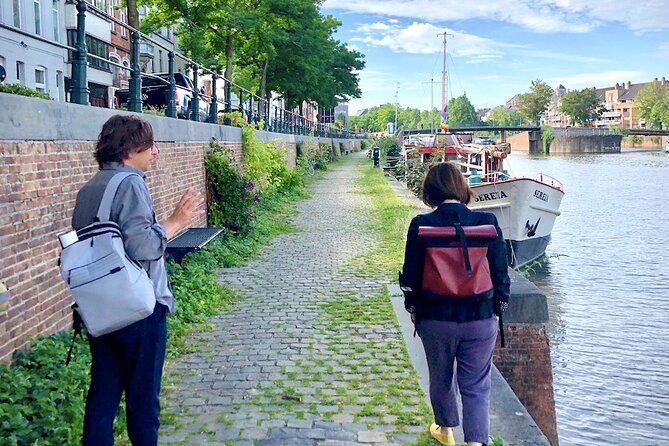
Hagelandkaai and the old moat of the Spanish Castle

The walk starts at Hagelandkaai 53, at Agelandkaai, beside the Napoleon De Pauw lock. This is more than a simple meeting point. The location marks where the moat around the Spanish Castle once ran during the 16th century.
That opening gives Jürgen a useful way to explain how Ghent changed over time. Water was central to the city’s growth, defense, and trade, and the first stop places you beside that old line of defense. You are not just looking at a modern waterfront. You are being shown how the city’s earlier shape survives beneath present-day streets and buildings.
The stop lasts about five minutes, so do not expect a long visit or an interior attraction here. Its value is as an introduction. If you enjoy understanding a city through maps, old fortifications, and changing urban boundaries, you will appreciate this start.
Bisdomkaai and the meeting of two rivers
From the old moat, the walk continues past the former St. Bavo’s Abbey toward the confluence of the Leie and Schelde rivers. This is presented as the place where Ghent began, making it one of the most important context stops on the route.
The visit to Bisdomkaai takes about ten minutes and has no admission fee. You get a chance to see the water and hear why this location mattered before Ghent became the city you see today.
I like this part because it gives the walk a clear beginning. Instead of treating medieval Ghent as a finished picture, Jürgen takes you back to the geographic reason the settlement developed. You might find this especially useful if you have little background on Belgian or Flemish history.
There is no formal attraction to enter here, so the experience depends on the explanation. On a rainy afternoon, the riverside can also be less comfortable. Still, it is a worthwhile stop because it gives meaning to the rest of the route.
St. Bavo’s Cathedral and the Lamb of God
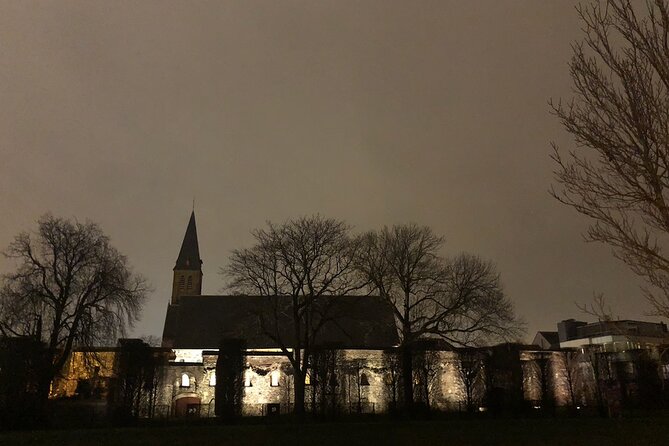
St. Bavo’s Cathedral is one of the walk’s major landmarks. The cathedral houses the Lamb of God, the famous work by Jan and Hubert van Eyck. The tour allows about ten minutes at the site, but cathedral admission is not included.
That short stop is best understood as an introduction rather than a full art visit. If the altarpiece is one of your main reasons for coming to Ghent, plan a separate visit inside. The cathedral has a virtual tour available, and it is described as worth adding to your time in the city.
The guide’s explanation can help you decide how much time to set aside for the interior. I would not try to squeeze the cathedral visit into the walking tour itself. Use the tour to understand the site, then return when you can give the artwork and building proper attention.
This is also a good example of the tour’s balance. You see famous sights, but the experience does not pretend that a quick exterior stop replaces a full admission visit.
More history walks around Ghent:
- Ghent: 40-Minute Historical Boat Tour of City Center
★ 4.3 · 430 reviews - Private Historical Tour: The Best of Ghent
★ 5.0 · 115 reviews - Bicycle tour in historic Ghent
★ 5.0 · 87 reviews - Chocolate history workshop Ghent
★ 5.0 · 34 reviews
Kouter and Ghent’s 18th and 19th centuries
At Kouter, the focus shifts from medieval origins to the atmosphere of 18th and 19th-century Ghent. The stop lasts around ten minutes and is free.
This change in period helps keep the walk from becoming a single march through the Middle Ages. Ghent’s identity was shaped by later wealth, civic life, and industry, and Kouter gives Jürgen a place to explain that evolution.
You may find this stop more useful than a standard photo pause because it helps show how the city’s public spaces changed. The tour is not only about castles and churches. It also looks at the social and economic life that developed around them.
The information available does not promise a long stay or a market visit at Kouter, so treat it as a guided setting rather than a standalone attraction. If you like architecture and city development, listen closely here.
Hotel d’Hane Steenhuyse and the quiet palace garden
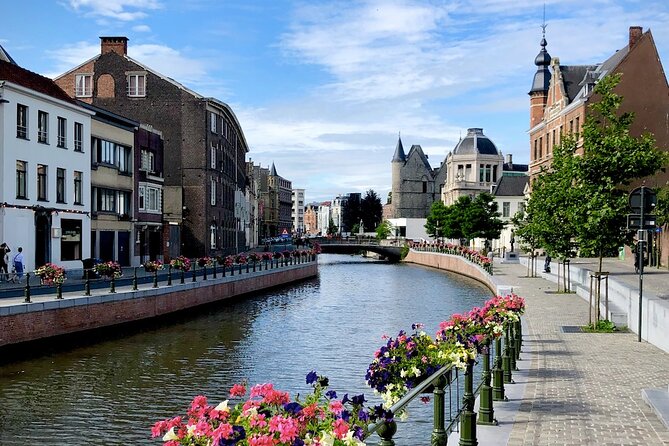
Hotel d’Hane Steenhuyse is an 18th-century city palace with ornate ceilings and decorations. It also has a beautiful garden described as a little-known secret. Admission is not included, and the stop lasts about ten minutes.
This is one of the route’s more appealing contrasts. Gravensteen and St. Bavo’s are major names, while this palace offers a glimpse of refined urban life on a smaller scale. The interiors, especially the ceilings and ornament, give you a sense of how wealthy residents lived in a later period.
I would check the interior access arrangements before building your day around it. The tour can point out the palace and explain its role, but the walk does not include admission. If you can enter, the garden sounds like a particularly good reason to allow extra time.
For me, this stop shows why a local guide adds value. A standard first-time route can easily focus only on the biggest monuments. Jürgen includes a place that may be less obvious but helps broaden your picture of Ghent.
Gravensteen, the Castle of the Counts
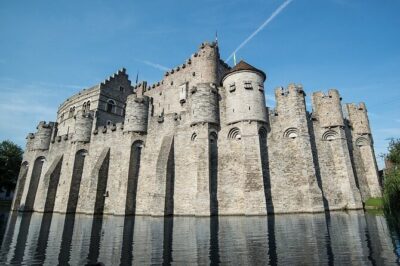
After a few additional sights along the way, the group reaches Gravensteen, the Castle of the Counts. This is one of Ghent’s defining landmarks, and the tour allows roughly ten minutes here. Admission is separate.
The castle is a strong point in the route because it links the city’s political past with its dramatic medieval appearance. You get the outside setting and the story, then you can decide if you want a full castle visit.
Do not expect the walking tour to cover every room or exhibit. Ten minutes is enough for orientation, exterior views, and historical context, not a complete museum experience. If you want to explore the castle in detail, plan another visit and budget for the entrance fee.
The short stop works well for people who want a city overview. It also prevents one attraction from taking over the entire afternoon. You see Gravensteen as part of Ghent’s larger story rather than as an isolated photo stop.
Patershol, one of Ghent’s oldest quarters

The walk continues into Patershol, one of the oldest parts of Ghent. The scheduled stop lasts about 15 minutes, and there is no admission fee.
This is where the route feels especially local. The narrow streets and old quarter give Jürgen room to explain how everyday life fitted into the city’s historic center. The stop is not only about monuments. It is about the texture of an older neighborhood and the way the city is used today.
Patershol is also practical for food. The area has many small restaurants, and the tour provider offers a 10 percent food discount at Enzo from Pizzeria Neapolis when you show one of their business cards. This is a specific perk, but confirm the details when you meet the guide so you know how to use it.
I would save Patershol for a return meal if your schedule allows. The tour’s food advice is one of its useful extras, particularly if you prefer local suggestions over choosing a restaurant at random.
Vrijdagmarkt and the story of Ghent’s socialist movement
The tour ends at Vrijdagmarkt, with an explanation of Ghent’s socialist movement. This final subject broadens the walk once again. You have moved from rivers and medieval power to palace life, old neighborhoods, and the political forces that shaped modern Ghent.
The stop lasts about 15 minutes and is free. The square also has restaurants and bars, making it an easy place to continue your evening. The stated end point is Oudburg 17, so you should confirm the exact finishing spot with Jürgen if you need to meet someone or catch transport.
Ending here is smart. You finish with a modern social and political angle instead of ending at the most obvious medieval sight. It leaves you with a more complete idea of Ghent, including the people and movements that shaped the city beyond its pretty facades.
You might also use the end of the tour to ask for advice on Sunday markets, drinks, food, or other places to see. Jürgen is known for answering questions and offering practical local suggestions, so have a few ready.
What $40.33 buys you
At $40.33 per person, this is not the cheapest way to walk around Ghent, but it offers more than a self-guided route. You are paying for two hours of structured explanation, local perspective, and access to a historian who can answer questions as you go.
The value improves if you are visiting Ghent for the first time. A city with as many layers as this one can be hard to decode from plaques alone. The guide helps you understand why the rivers matter, how the old quarters fit together, and how the city moved from medieval power to later civic and industrial life.
The price is also easier to justify for a couple, family, or small group that wants a private-style experience without booking a large private vehicle or full-day guide. The maximum group size is 20, but the tour can be much smaller. One outing had only three people, which allowed plenty of questions and a more personal pace.
Remember that admission to St. Bavo’s Cathedral, Hotel d’Hane Steenhuyse, and Gravensteen is not included. Add those costs only if you plan to go inside. The walking tour itself is primarily about the city streets, views, and explanations.
Who should book this walk?
I would recommend it to first-time visitors, history fans, and anyone who wants a local introduction before exploring Ghent alone. It also suits people who prefer questions and conversation over a recorded audio guide.
The tour can work for newcomers who have recently moved to Ghent, too. The guide offers suggestions for markets and places to eat, not just monument facts. That practical help can make the city easier to navigate after the walk ends.
You should think twice if you want long visits inside every major attraction. This is a moving overview, not a cathedral, palace, or castle tour. You should also be ready to walk outdoors for about two hours and accept that weather may affect comfort.
The provider allows service animals, the tour is near public transportation, and most people can participate. The experience requires a minimum number of participants, though a full refund or another option is offered if the provider cancels for that reason. You can cancel for a full refund up to 24 hours before the 3 p.m. start time.
Should you book Historic Highlights in Ghent?
Book it if you want Ghent explained by someone who teaches history, grew up locally, and enjoys talking about the city beyond its most famous sights. Jürgen’s route gives you the rivers, cathedral, palace, castle, old quarter, and socialist history in a compact two-hour walk.
I would choose this tour near the start of your stay, then return to St. Bavo’s, Gravensteen, or the palace if you want a closer look inside. The separate admissions are the main extra cost, and the weather is the main practical risk.
For a quick, personal introduction to Ghent with useful food and market advice, $40.33 is a fair price. If you prefer to explore silently at your own pace, you can cover the same streets for less. You will miss, however, the stories that turn Ghent from a handsome backdrop into a city with a clear past and present.
FAQ
Where does the Ghent walking tour start?
The tour starts at Hagelandkaai 53, 9000 Gent, Belgium, near the Napoleon De Pauw lock.
What time does the tour begin?
The scheduled start time is 3 p.m.
How long does Historic Highlights last?
The walking tour lasts approximately two hours.
Where does the tour end?
The listed end point is Oudburg 17, 9000 Gent, Belgium, near Vrijdagmarkt.
Who guides the tour?
The guide is Jürgen, a local history professor who was born and raised in Ghent.
Are admission fees included?
No. Admission is not included for St. Bavo’s Cathedral, Hotel d’Hane Steenhuyse, or Gravensteen.
How many people can join?
The tour has a maximum of 20 participants. It may also operate with a much smaller group.
Can I cancel for a full refund?
Yes. You can cancel at least 24 hours before the experience start time for a full refund. Changes or cancellations made less than 24 hours before the start are not accepted for a refund.
Just added around Ghent
- Discover Ghent while playing! Escape game – The alchemist★ 4.0 · 4 reviews
- Walking Food Tour in Ghent★ 5.0 · 13 reviews
- Discover Ghent while playing! Escape game – The Walter case★ 4.5 · 4 reviews
- Discover Ghent with a self-guided Outside Escape city game tour!★ 4.0 · 10 reviews
- e-Scavenger hunt Kortrijk: Explore the city at your own pace★ 4.5 · 15 reviews
- Ghent Walking Tour with Audioguide on Your Smartphone★ 4.5 · 13 reviews
- Private Ghent Beer & Brewery Tour by a young local★ 5.0 · 12 reviews
- Private Hidden Gems Walking Tour in Ghent★ 5.0 · 12 reviews
Historical Tours, compared.



Historical Walking Tour with Chocolate & Waffle Tasting
Read our review →
THE Storytelling Tour of Bruges | First Day Must | History & Tips
Read our review →
Tell Me About Brussels! | First Day Must-Do | Local Storytellers
Read our review →Browse the lists this tour appears in